| McWhinney's Centerra Gets More Taxes - Mill Levy cap increased from 35 to 72 with few objections from Council Metropolitan District Points To School District As Cause For Increase |
| The Loveland City Council unanimously passed a resolution stating the Centerra mill levy is insufficient. At Tuesday night’s Council meeting they unanimously provided authority to increase mill levies (property taxes) that go to the Centerra Metropolitan Districts for public improvements. The previous cap of 35 mills is being replaced with an authority to tax up to 72 mills on the commercial properties in the McWhinney’s 3,000 acre Centerra development. The revenue generated by the 25 year tax increase will not go to public agencies but instead be funneled back to the development for infrastructure related to the Centerra project. Commercial property owners in the Centerra taxing districts were not asked to vote on the increase but were notified in-advance of the proposed change by the City of Loveland. The resolution passed unanimously with Councilwoman Jan Brown the only one absent from the meeting. The resolution states; “The Centerra development will result in a significant shortfall in revenues available to finance the public improvementsâ€� The Redevelopment Agency for Centerra, represented by Rich Sannon of McWhinney Enterprises, asked the City Council to amend the MFA (Master Financing Agreement) for Centerra to allow for the raising of property taxes by a â €œnet effect of 10% to 15%â€� according to Shannon. The Council approved eliminating the previous cap placed on the redevelopment authority thus allowing increases in the future without further consultation of the City Council. The fluctuating school district mill levies (two going down and another up) were blamed as the cause for the change since current projections are showing a revenue shortfall into the future and the recently passed mill levy for the Thompson School District will reduce the amount of money anticipated for Centerra. However, current revenue is far exceeding the projections and this caused some confusion by the City Councilman paying close attention who also read his briefing packet. Faulty Financial Projections to Blame on Revenue Discrepencies The primary reason for the discrepancy of higher than expected revenues has been the way the County of Larimer assesses values on the properties impacted by the mill levy. The Centerra Metropolitan Districts receive what is called a “tax increment" also called a TIF. This is the amount of additional taxes generated by the higher value of the property as a result of the improvements made to the land thus increasing tax revenues for the County that are redistributed to various entities including the schools district and Centerra. The McWhinney’s, city planners and the redevelopment authority staff all assumed only developed properties (ones with buildings) could be tax by the County at higher rates when the projections were created in 2004. Thus, the only tax increment (which results from higher assessed property values) could be generating additional revenue would be the developed areas. Instead, the County Assessor has also raised the value of property not yet developed. The fault lies in the fact that not only the developed lots were appraised by the Larimer County Assessor to be of higher value. When several parcels were re- zoned from agricultural and maybe one of the five lots was improved, the County accurately assessed the still vacant land at its now higher commercial value. The higher tax assessments resulted in additional tax revenues for local governments. As these lots are built-out the discrepancy between the projected taxes and actual taxes will shrink and the overall income to the McWhinney’s project infrastructure fund will decrease. In a discussion that lasted nearly one hour, Councilman Klassen questioned the need for the increase since the report provided to Council demonstrated that Centerra tax collections on property have far outpaced projections. As an example, in the original plan adopted in 2004, projections showed a 2006 revenue at $122,100 when instead the revenue from the special mill levy for the Centerra Metropolitan Districts was $704,133. This year the number is expected to be close to $3.8 million when the projected amount was only $1.5 million in 2007. The Mayor announced earlier in the meeting that the issue was to be postponed (as the Council had already been informed) but it was decided to go forward anyway. Mayor Walsh stated, " Item number 11, you heard this would be postponed...I donâ €™t know if some members didn’t think it would be covered. Maybe you didnâ €™t read it." Councilman Walt Skowron responded, "We don’t have a very cumbersome agenda tonight so I am ready to hear it if others agree." Councilman Larry Heckel stated, "When I saw the thing in there I didn’t read it but I am not very opinionated anyway so we might as well go ahead." School District Measure is Blamed Coming tomorrow – complete story on the role the three different school district mill levies play on the final property tax for commercial property owners. While there is no contractual or legal linkage between the changing school mill levies in Centerra and the proposed increase, the fluctuating mill levies associated with school funding are being blamed as the primary reason for the change. |
LovelandPolitics.com

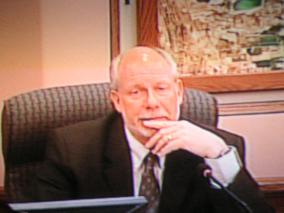
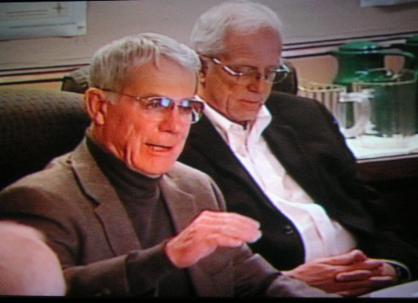
| Councilman Klassen appeared to be the only Councilor trying to sort through the complicated tax issue while Mayor Pro Tem Gene Pielin appeared to be napping. |
| Councilman Dave Clark seemed to be in a daze as the hour long discussion progressed over the mill levy distributions for Centerra |
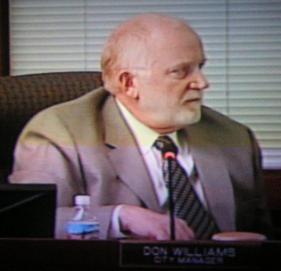
| The City Manager, Don Williams, is seen here interjecting the point to Council that the Resolution before them allows the Redevelopment Authority the right to raise the mill levy but doesn't actually raise the mill levy. |
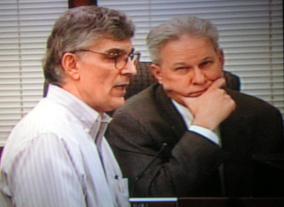
| City Attorney, John R. Duval, watches closely as Rich Shannon of McWhinney Enterprises explains the mill levy cap increase to the City Council |
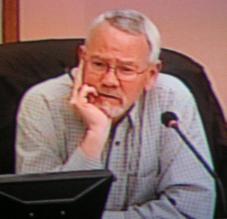
| Councilman Glenn Rousey listened intently to the presentation and subsiquent questions from his colleagues. |
| Read the question and answer exchange between Council and McWhinney representative regarding the timing more.... |