| NEWS BLOG |


LovelandPolitics
| Loveland's Independent News Source |
| Loveland Staff May Be Planning A Second Mexican Intersection |
Loveland October 4, 2012
LovelandPolitics has learned City of Loveland public works staff are quietly urging the installation of a second Continuous Flow Intersection (CFI)
at the corner of Highway 34 and Boise Ave. just east of the city's first and highly controversial CFI located now at Highway 34 and Madison Ave.
According to a confidential city source, the real estate required to install traditional turn lanes would consume most of the parking area in front of
the Weedin Insurance building on the northeast corner of Highway 34 and Boise Ave.
The CFI allows traffic turning left to flow at the same time (thus continuous) as traffic moving against it in the opposite direction by creating a left
lane to the right side of the oncoming traffic. For example, if east-west signals turn green than both the left and through traffic may proceed at
the same time while the traffic is moving, lefts on the east-west side cross oncoming traffic at an earlier signal at mid-block. Once the north-south
traffic signals turn green both the through traffic and left lanes can proceed simultaneously because the left turning vehicles have already
crossed over to the other side of opposing traffic flow. Loveland's CFI at Highway 34 and Madison is a partial CFI as not every left turning lane
crosses opposing traffic at mid-block.
The City of Loveland was an early adopter of CFI's in the United States when it spent some $4 million in 2010 to install the complicated CFI at
Highway 34 and Madison Ave. Building an overpass at the same intersection was estimated to cost between $12 and $15 million.
Known as "Mexican Intersections" the CFI was invented by Mexican civil engineer Francisco Mier and a colleague. Mier invented the intersection
for Mexican highways where at-grade cross traffic was too heavy for a normal intersection and the usual first-world option of building an overpass
was not affordable to the municipalities and provincial governments of the impoverished nation. CFI's are commonly referred to as "Mexican
intersections" not only because they were invented in Mexico (for years Mier collected a royalty for every CFI built) but also because they have
become the preferred option to an overpass in many intersections of Mexico's largest cities for the past 20 years. Anyone who has driven a car in
Mexico City or Guadalajara in the last 20 years has likely navigated CFI in the busiest parts of the cities.
A relative newcomer to the United States, the Mexican intersection is not as popular as tequila, tacos or other imports from Mexico maybe
because most people looking for better traffic planning don't think of looking south of the border. In this case, Loveland sources estimate a
traditional overpass could cost as much as $15 million while the CFI costs less than $5 million. Of course, the overpass is considered the best
and safest possible resolution to an overcrowded intersection while a CFI is the at-grade third world alternative.
Did The Mexican Intersection At 34 & Madison Cost People Their Businesses?
An often cited rumor regarding Loveland's first Mexican Intersection is its impact on the surrounding businesses; especially those at mid-block
where ingresses and egresses to the business are restricted as a result of the installing the Mexican intersection. Following its installation in
2010 at 34 and Madison Ave., the flower shop on the southeast corner is rumored to have changed hands several times and Penguin Ice Cream
went out of business located near the mid-block of Madison north of Highway 34.
The former owner of the car wash just south of the intersection has blamed the city's "innovative" intersection on the failure and ultimate sale of
his once booming business. Customers of the mostly self-service car wash east of Sam's Club near the Home Depot parking lot can no longer
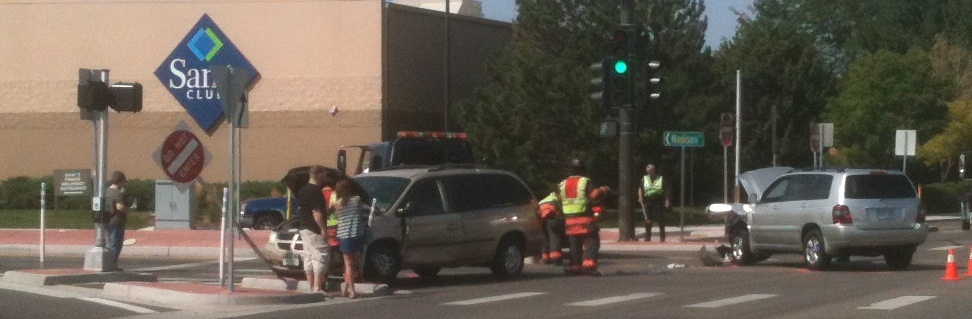
turn left heading north on Madison as the result of changes made to install the CFI. Critics of the CFI's complain the statistics gathered by city
staff ignore the fact the CFI restricts certain traffic patterns thus eliminating driver choices and ultimately the number of accidents. According to
one business owner who spoke off-the-record, "of course there are less accidents statistically because me and everybody else I know avoid
that intersection like the plague."
While city staff acknowledge there is some avoidance upon installation they also argue those looking to enter Highway 34 during morning and
evening rush hours can now do so with less waiting time than before. In 2011 the City of Loveland conducted an extensive survey of the
intersection that concluded it was a net positive for the community with less overall accidents and increased traffic flow. According to David W.
Klockeman, PE City Engineer for Loveland's Public Works Department, "We are continuing to monitor this intersection, as we do all across
Loveland to determine if additional study and/or modifications are necessary."
Link to Loveland's 2011 study of the Mexican Intersection at Highway 34 and summary of 10 traffic accidents at the intersection during
the first 6 months of 2011.
Candidates for public office may argue differently than city staff who say the intersection has been a success. As they walk door to door and
report hearing complaints from voters about the strange intersection tension appears to rise within city hall over whether or not the elected
officials will support a second Mexican intersection in Loveland. While LovelandPolitics has not conducted a scientific survey of the publics
reaction to Loveland's first CFI, 100% of comments we have received about that intersection at Highway 34 and Madison Ave.from the public have
been negative.
Council Politics and Mexican Intersections
Whether staff is successful selling a second Mexican intersection to Loveland's City Council remains to be seen. In the meantime, Loveland
residents may witness officials from other cities visiting the site by watching traffic from lawn chairs as Loveland's "success" installing a CFI
spreads to other cities looking for cheaper solutions to an overpass when addressing busy intersections.
On June 2, 2004 the Loveland Reporter-Herald published a story by Dave Brendsel regarding then Councilman Don Marostica receiving a waiver
from the city's conflict of interest laws to advocate for his own development named Boise Village located south of Highway 34 on Boise Ave.
Below is excerpt from that article,
"The Loveland City Council approved a development proposed by one of its members Tuesday and granted that member an exception to the city’
s conflict-of-interest law. “This doesn’t seem like a conflict,” said Councilman Dave Clark, a commercial developer. “There is no profit at all
involved.” Although Councilman Don Marostica hopes to profit from the development, Clark said developers make no money from the type of
contracts required by the city.
The council voted 6-1 to approve Boise North, a development proposed by Marostica and Eric Holsapple, partners in Loveland Commercial, a
local development company. The company plans to build 237 homes and small industrial and commercial lots on 75 acres along 11th Street
between Denver and Boise avenues.
The council changed the master plan, waived city traffic standards and rezoned the property to allow it to move forward. Councilman Walt
Skowron voted against the development, citing traffic concerns. The council also gave Marostica an exception to the city’s conflict-of-interest law
Tuesday on a 7-1 vote, with Skowron voting against the exception."
Marostica's Boise Village included 53 "qualified" affordable units allowing Loveland Commercial to subdivide the lots while not paying the
necessary CEF's (Capital Expansion Fees) customarily due the city to offset the cost of various improvements including transportation
infrastructure. Now the hundreds of new residents who bought homes in Boise Village and other subsequent "incentivised" affordable Marostica
developments need access to Highway 34 from Boise Ave. which hasn't been adequately improved to handle the increased traffic flow.
Buckhorn Village and other developments have also taken advantage of the city's affordable housing exemption (as amended in 2009 - see
below) by failing to pay the necessary fees associated with the increased traffic they create. Even when developments fail to meet the city's
deadline or criteria the exemption is often extended indefinitely by council.
16.38.080 Exemption from capital expansion fees - qualified affordable housing.
A. The city council may by resolution grant an exemption from all or part of the capital expansion fees or any other fees imposed by the city upon
new development, whether for capital or other purposes, upon a finding, set forth in a development agreement, that the project for which the fees
would otherwise be imposed is a qualified affordable housing development. When a capital-related fee is waived pursuant to this section, there
shall be no reimbursement to the capital expansion fund by the general fund or any other fund
City staff is recommending Loveland's second Mexican style intersection as a way to mitigate the impacts of more houses but no money for
transportation improvements. Many of the traffic mitigation fee waivers have had a deleterious effect on the city's ability to grow infrastructure
commensurate with the population increases over the past decade.
LovelandPolitics has learned City of Loveland public works staff are quietly urging the installation of a second Continuous Flow Intersection (CFI)
at the corner of Highway 34 and Boise Ave. just east of the city's first and highly controversial CFI located now at Highway 34 and Madison Ave.
According to a confidential city source, the real estate required to install traditional turn lanes would consume most of the parking area in front of
the Weedin Insurance building on the northeast corner of Highway 34 and Boise Ave.
The CFI allows traffic turning left to flow at the same time (thus continuous) as traffic moving against it in the opposite direction by creating a left
lane to the right side of the oncoming traffic. For example, if east-west signals turn green than both the left and through traffic may proceed at
the same time while the traffic is moving, lefts on the east-west side cross oncoming traffic at an earlier signal at mid-block. Once the north-south
traffic signals turn green both the through traffic and left lanes can proceed simultaneously because the left turning vehicles have already
crossed over to the other side of opposing traffic flow. Loveland's CFI at Highway 34 and Madison is a partial CFI as not every left turning lane
crosses opposing traffic at mid-block.
The City of Loveland was an early adopter of CFI's in the United States when it spent some $4 million in 2010 to install the complicated CFI at
Highway 34 and Madison Ave. Building an overpass at the same intersection was estimated to cost between $12 and $15 million.
Known as "Mexican Intersections" the CFI was invented by Mexican civil engineer Francisco Mier and a colleague. Mier invented the intersection
for Mexican highways where at-grade cross traffic was too heavy for a normal intersection and the usual first-world option of building an overpass
was not affordable to the municipalities and provincial governments of the impoverished nation. CFI's are commonly referred to as "Mexican
intersections" not only because they were invented in Mexico (for years Mier collected a royalty for every CFI built) but also because they have
become the preferred option to an overpass in many intersections of Mexico's largest cities for the past 20 years. Anyone who has driven a car in
Mexico City or Guadalajara in the last 20 years has likely navigated CFI in the busiest parts of the cities.
A relative newcomer to the United States, the Mexican intersection is not as popular as tequila, tacos or other imports from Mexico maybe
because most people looking for better traffic planning don't think of looking south of the border. In this case, Loveland sources estimate a
traditional overpass could cost as much as $15 million while the CFI costs less than $5 million. Of course, the overpass is considered the best
and safest possible resolution to an overcrowded intersection while a CFI is the at-grade third world alternative.
Did The Mexican Intersection At 34 & Madison Cost People Their Businesses?
An often cited rumor regarding Loveland's first Mexican Intersection is its impact on the surrounding businesses; especially those at mid-block
where ingresses and egresses to the business are restricted as a result of the installing the Mexican intersection. Following its installation in
2010 at 34 and Madison Ave., the flower shop on the southeast corner is rumored to have changed hands several times and Penguin Ice Cream
went out of business located near the mid-block of Madison north of Highway 34.
The former owner of the car wash just south of the intersection has blamed the city's "innovative" intersection on the failure and ultimate sale of
his once booming business. Customers of the mostly self-service car wash east of Sam's Club near the Home Depot parking lot can no longer
turn left heading north on Madison as the result of changes made to install the CFI. Critics of the CFI's complain the statistics gathered by city
staff ignore the fact the CFI restricts certain traffic patterns thus eliminating driver choices and ultimately the number of accidents. According to
one business owner who spoke off-the-record, "of course there are less accidents statistically because me and everybody else I know avoid
that intersection like the plague."
While city staff acknowledge there is some avoidance upon installation they also argue those looking to enter Highway 34 during morning and
evening rush hours can now do so with less waiting time than before. In 2011 the City of Loveland conducted an extensive survey of the
intersection that concluded it was a net positive for the community with less overall accidents and increased traffic flow. According to David W.
Klockeman, PE City Engineer for Loveland's Public Works Department, "We are continuing to monitor this intersection, as we do all across
Loveland to determine if additional study and/or modifications are necessary."
Link to Loveland's 2011 study of the Mexican Intersection at Highway 34 and summary of 10 traffic accidents at the intersection during
the first 6 months of 2011.
Candidates for public office may argue differently than city staff who say the intersection has been a success. As they walk door to door and
report hearing complaints from voters about the strange intersection tension appears to rise within city hall over whether or not the elected
officials will support a second Mexican intersection in Loveland. While LovelandPolitics has not conducted a scientific survey of the publics
reaction to Loveland's first CFI, 100% of comments we have received about that intersection at Highway 34 and Madison Ave.from the public have
been negative.
Council Politics and Mexican Intersections
Whether staff is successful selling a second Mexican intersection to Loveland's City Council remains to be seen. In the meantime, Loveland
residents may witness officials from other cities visiting the site by watching traffic from lawn chairs as Loveland's "success" installing a CFI
spreads to other cities looking for cheaper solutions to an overpass when addressing busy intersections.
On June 2, 2004 the Loveland Reporter-Herald published a story by Dave Brendsel regarding then Councilman Don Marostica receiving a waiver
from the city's conflict of interest laws to advocate for his own development named Boise Village located south of Highway 34 on Boise Ave.
Below is excerpt from that article,
"The Loveland City Council approved a development proposed by one of its members Tuesday and granted that member an exception to the city’
s conflict-of-interest law. “This doesn’t seem like a conflict,” said Councilman Dave Clark, a commercial developer. “There is no profit at all
involved.” Although Councilman Don Marostica hopes to profit from the development, Clark said developers make no money from the type of
contracts required by the city.
The council voted 6-1 to approve Boise North, a development proposed by Marostica and Eric Holsapple, partners in Loveland Commercial, a
local development company. The company plans to build 237 homes and small industrial and commercial lots on 75 acres along 11th Street
between Denver and Boise avenues.
The council changed the master plan, waived city traffic standards and rezoned the property to allow it to move forward. Councilman Walt
Skowron voted against the development, citing traffic concerns. The council also gave Marostica an exception to the city’s conflict-of-interest law
Tuesday on a 7-1 vote, with Skowron voting against the exception."
Marostica's Boise Village included 53 "qualified" affordable units allowing Loveland Commercial to subdivide the lots while not paying the
necessary CEF's (Capital Expansion Fees) customarily due the city to offset the cost of various improvements including transportation
infrastructure. Now the hundreds of new residents who bought homes in Boise Village and other subsequent "incentivised" affordable Marostica
developments need access to Highway 34 from Boise Ave. which hasn't been adequately improved to handle the increased traffic flow.
Buckhorn Village and other developments have also taken advantage of the city's affordable housing exemption (as amended in 2009 - see
below) by failing to pay the necessary fees associated with the increased traffic they create. Even when developments fail to meet the city's
deadline or criteria the exemption is often extended indefinitely by council.
16.38.080 Exemption from capital expansion fees - qualified affordable housing.
A. The city council may by resolution grant an exemption from all or part of the capital expansion fees or any other fees imposed by the city upon
new development, whether for capital or other purposes, upon a finding, set forth in a development agreement, that the project for which the fees
would otherwise be imposed is a qualified affordable housing development. When a capital-related fee is waived pursuant to this section, there
shall be no reimbursement to the capital expansion fund by the general fund or any other fund
City staff is recommending Loveland's second Mexican style intersection as a way to mitigate the impacts of more houses but no money for
transportation improvements. Many of the traffic mitigation fee waivers have had a deleterious effect on the city's ability to grow infrastructure
commensurate with the population increases over the past decade.