| LovelandPolitics.com |

| Is Red Concrete Loveland's Newest Form of Art? "Uglification" of Wilson Ave. Now Complete |
Residents who travel Wilson Ave. between 29th Street and Highway 34 in Loveland
couldn’t have missed the large signs proclaiming an “improvement” project funded by
government stimulus dollars administered by the State of Colorado this past summer
and fall. Proudly listed on the sign as facilitating the improvement was Colorado
Governor Bill Ritter. Had he or any other politicians been fully aware of the extent of
the “improvements” they might have asked to have their names taken off the signs.
Residents weary of the ongoing efforts to remove the trees from the median in previous
years by the City of Loveland Public Works Department were encouraged by the
signs advertising federally funded improvements which were being implemented along
Wilson Ave. Perhaps the lack of funds or the damage caused by magnesium chloride
could no longer be used as an excuse to “Uglify Wilson” as first reported in 2005 by
LovelandPolitics.
Instead of improving the aesthetics of the street and surrounding areas the quality
plummeted when the project finished and the removal of construction equipment,
pylons and warning signs revealed a sea of red concrete with awful looking plastic
tubes sticking out to mark the medians.
Going north into Ft. Collins along Wilson Ave. where it becomes Taft Hill Ave, one
will discover not only landscaping in the median but concrete faux brick work in the
narrower sections of the medians of natural stone colors instead of the artificial red
concrete that now seems ubiquitous on Loveland roadways.
Recent improvements near the intersection of Shields and Harmony in Ft. Collins also
shows attention to detail with the use of landscaping in the wider areas of the medians.
This not only enhances the appearance of the road but helps to buffer the mass of
asphalt and concrete dedicated to the roadway.
Contrary to what some have reported to LovelandPolitics, Loveland’s Director of
Public Works, Keith Reester, is not always opposed to landscaping medians nor trying
to avoid the trouble of future maintenance. This is because Loveland’s Parks
Department is responsible for maintaining the landscaping on the medians while Public
Works is responsible for installing or supervising the installation of medians.
Poor Long-term Community Planning?
The city engineers will argue the best way to keep traffic flowing along Loveland’s
primary traffic arteries is to remove merging traffic (both departing and entering traffic
flow) from the main traffic lanes. This is accomplished by creating longer turn lanes so
that vehicles turning left can line-up in a dedicated turn lane while traffic entering the
roadway have a longer lane to gain speed before attempting to merge.
couldn’t have missed the large signs proclaiming an “improvement” project funded by
government stimulus dollars administered by the State of Colorado this past summer
and fall. Proudly listed on the sign as facilitating the improvement was Colorado
Governor Bill Ritter. Had he or any other politicians been fully aware of the extent of
the “improvements” they might have asked to have their names taken off the signs.
Residents weary of the ongoing efforts to remove the trees from the median in previous
years by the City of Loveland Public Works Department were encouraged by the
signs advertising federally funded improvements which were being implemented along
Wilson Ave. Perhaps the lack of funds or the damage caused by magnesium chloride
could no longer be used as an excuse to “Uglify Wilson” as first reported in 2005 by
LovelandPolitics.
Instead of improving the aesthetics of the street and surrounding areas the quality
plummeted when the project finished and the removal of construction equipment,
pylons and warning signs revealed a sea of red concrete with awful looking plastic
tubes sticking out to mark the medians.
Going north into Ft. Collins along Wilson Ave. where it becomes Taft Hill Ave, one
will discover not only landscaping in the median but concrete faux brick work in the
narrower sections of the medians of natural stone colors instead of the artificial red
concrete that now seems ubiquitous on Loveland roadways.
Recent improvements near the intersection of Shields and Harmony in Ft. Collins also
shows attention to detail with the use of landscaping in the wider areas of the medians.
This not only enhances the appearance of the road but helps to buffer the mass of
asphalt and concrete dedicated to the roadway.
Contrary to what some have reported to LovelandPolitics, Loveland’s Director of
Public Works, Keith Reester, is not always opposed to landscaping medians nor trying
to avoid the trouble of future maintenance. This is because Loveland’s Parks
Department is responsible for maintaining the landscaping on the medians while Public
Works is responsible for installing or supervising the installation of medians.
Poor Long-term Community Planning?
The city engineers will argue the best way to keep traffic flowing along Loveland’s
primary traffic arteries is to remove merging traffic (both departing and entering traffic
flow) from the main traffic lanes. This is accomplished by creating longer turn lanes so
that vehicles turning left can line-up in a dedicated turn lane while traffic entering the
roadway have a longer lane to gain speed before attempting to merge.
| "From a Public Works perspective medians that have more plant life are certainly positive, attractive, and provide sustainability benefits. We have also received many negative comments over the years related to xeriscaped medians, as one might see in Phoenix or Tucson; so we are also balancing the sustainability of heavy watering and maintenance of these areas as well." Keith Reester City of Loveland Director of Public Works Dec. 3, 2009 |
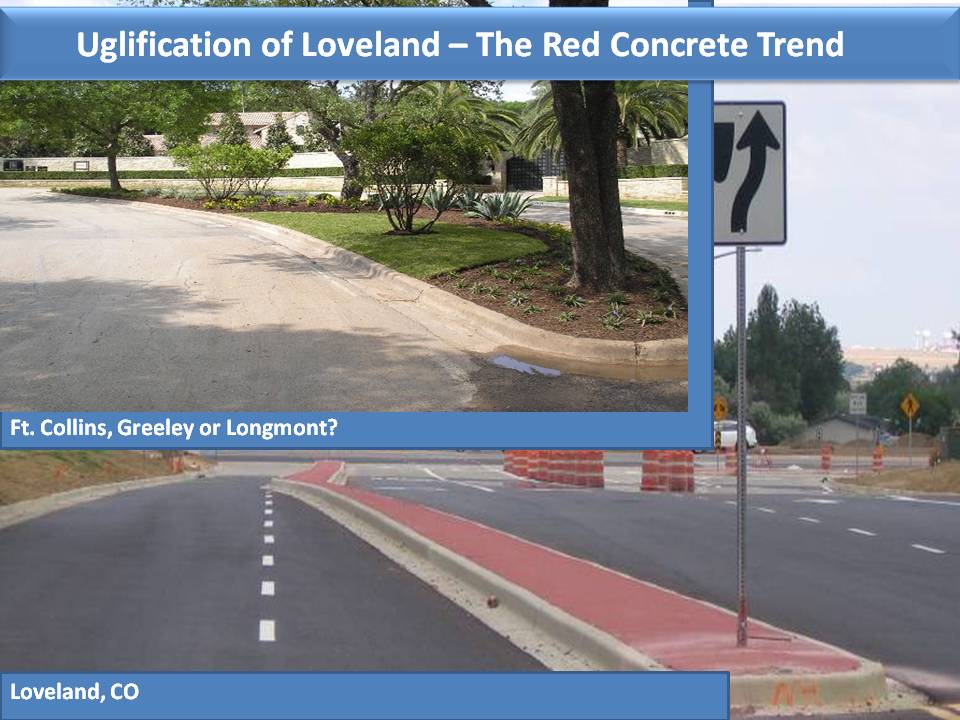
Wilson Ave. is among many roads in Loveland where the ROW (Rights of Way) do not allow for both the longer turn lanes and the traditional wide median. Therefore, the medians
are reduced to narrow concrete strips instead of the street widened to accommodate increasing traffic flow.
After a decade of city councils like that dominated by former councilman Don Marostica waiving fees for any traffic mitigation impacts by commercial and residential development, the
funds to enlarge ROW don’t appear to be available nor are the funds to fix existing traffic congested areas.
Therefore, Wilson Ave. represents a growing problem in the community where new residential areas have been approved without any long-term plan to accommodate that growth
with streets capable of handingling the growing traffic flow. Similar to overbuilt and cash strapped urban areas, Loveland has begun sacrificing the medians and the landscaping to
increase the traffic carrying capacity of those roadways.
Ironically, a narrower median may allow for longer turning lanes but doesn’t necessarily improve traffic safety. This is because head-on collisions are nearly unheard of when the
offending vehicle needs to travel over a large median landscaped with trees and bushes. Narrow strips of concrete between oncoming traffic are easily traversed by drivers who are
not paying attention or have fallen asleep.
Wilson Ave. does, however, have at least four areas between 29th Street and Highway 34 that are wider than 5 feet and could accommodate some landscaping but instead are now
paved in red concrete. While trees may create a hazards for drivers who jump the median (a concern expressed by the State of Colorado regarding trees in medians) they also serve
as the best possible visible sign of demarcation between opposing lanes of traffic during a heavy snow storm.
Loveland is just now facing the inevitable consequence of unplanned growth where the council and planning commission have too often waived important traffic impact fees or
requirements that an alternative ingress be provided to the development. Reducing existing roads into crowded corridors lacking any aesthetic value or landscaping will ultimately cost
the entire community not only in aesthetics but also perceived overall quality of life for everyone not to mention property values.
Loveland's new city council needs to carefully consider all these issues when making appointments to the Planning Commission as well.
are reduced to narrow concrete strips instead of the street widened to accommodate increasing traffic flow.
After a decade of city councils like that dominated by former councilman Don Marostica waiving fees for any traffic mitigation impacts by commercial and residential development, the
funds to enlarge ROW don’t appear to be available nor are the funds to fix existing traffic congested areas.
Therefore, Wilson Ave. represents a growing problem in the community where new residential areas have been approved without any long-term plan to accommodate that growth
with streets capable of handingling the growing traffic flow. Similar to overbuilt and cash strapped urban areas, Loveland has begun sacrificing the medians and the landscaping to
increase the traffic carrying capacity of those roadways.
Ironically, a narrower median may allow for longer turning lanes but doesn’t necessarily improve traffic safety. This is because head-on collisions are nearly unheard of when the
offending vehicle needs to travel over a large median landscaped with trees and bushes. Narrow strips of concrete between oncoming traffic are easily traversed by drivers who are
not paying attention or have fallen asleep.
Wilson Ave. does, however, have at least four areas between 29th Street and Highway 34 that are wider than 5 feet and could accommodate some landscaping but instead are now
paved in red concrete. While trees may create a hazards for drivers who jump the median (a concern expressed by the State of Colorado regarding trees in medians) they also serve
as the best possible visible sign of demarcation between opposing lanes of traffic during a heavy snow storm.
Loveland is just now facing the inevitable consequence of unplanned growth where the council and planning commission have too often waived important traffic impact fees or
requirements that an alternative ingress be provided to the development. Reducing existing roads into crowded corridors lacking any aesthetic value or landscaping will ultimately cost
the entire community not only in aesthetics but also perceived overall quality of life for everyone not to mention property values.
Loveland's new city council needs to carefully consider all these issues when making appointments to the Planning Commission as well.
| "Loveland’s paved roadways continue to feature a sea of concrete and asphalt with little sense of aesthetics." Loveland Reporter-Herald Editorial Dec. 3, 2009 |