| TOP TEN ISSUES CONCERNING RTA PROPOSAL RTA (Regional Transportation Authority) Proposal Scheduled For Review By Loveland's City Council on June 12, 2007 at their regular study session (no public comment will be allowed) |
LovelandPolitics.com

1. The Proposal Is Contrary to RTA’s Guiding Principles.
The proposal by the RTA Steering Committee does not match the Guiding Principles that were established prior to the
convening of the RTA Steering Committee. One defense provided for this is the fact the guiding principles were not
affirmed by the larger group of 34 members. However, the Steering Committee was never given the option of selecting
what part of their charter they wanted to ignore and that which they intended to follow.
2. Proposal Provides Subsidies To Private Developments / Proposes Loveland
Residents Pay Twice For Same Improvements
Approximately $38 Million of the proposed allocation would go to cover road improvement projects which are the direct
legal responsibility of the Centerra Metro District, under their Master Finance Agreement with the City of Loveland. That
agreement requires the developer to fund such projects as both Interim and “Ultimate� improvements for I-25/
US34 Interchange, the Crossroads Blvd interchange, and more.
Using new public taxes for those purposes means Loveland residents will be paying twice for the same improvements.
Seven of the twenty road improvements McWhinneys promised to accomplish with Loveland’s future sales tax
revenue will instead be paid for through the RTA tax increase. This is a huge windfall for the developer.
3. It forces local taxpayers to subsidize federal and state governments.
In placing a substantial portion of road capital allocations for I-25 Interchange improvements and for US34, the RTA
Proposal directly violates the 5th Principle: “[RTA] funds do not replace funds from the federal and state governments
and do not relieve them of their obligations to Northern Colorado.� Since locally-generated taxes would now be applied
to federal and state responsibilities, and since there is no mechanism for “pay back� of such expenditures, essentially
local taxpayers are subsidizing the state and federal governments.
RTA funds were meant to pay for critical regional transportation needs. As such these funds should not be used to replace
funds from the federal and state governments and should not relieve these governments of their obligations to Northern
Colorado. If accepted, the RTA proposal will take the unprecedented step of making local taxpayers cover the
responsibilities of both federal and state governments without any agreements or mechanics in place to insure such money
is repaid.
4. Regional Public Transit Portion of the Proposal has Fatal Flaws.
The success of intra- and inter-regional transit (i.e. city to city) is significantly dependent on how well the local (municipal)
transit system works. That is, if commuters can’t get to the “regional� connection station from home or office,
or can not get from it to their destination, i.e. via local public transit, then the regional service will not be effective or
successful.
This issue was identified early and often during the deliberations by the RTA Steering Committee. It is clear that some
communities (Greeley and especially Loveland) have very ineffective local transit operations where public participation is
very low. This means that FC-Loveland or Loveland-Greeley transit will likely remain ineffective also. The official RTA
proposal does not address this gap because it does not allocate any revenue for local transit improvements. While it does
not prohibit entities from using “Shareback� revenues for that purpose, this isn’t helpful. This is because in the
case of Loveland there will be little incentive or likelihood of Loveland’s use of shareback for local transit, given that
Loveland’s priorities are clearly larger roads to empty commercial lots owned or managed by Loveland Commercial
instead of improving public transportation by relieving existing congestion.
5. Proposal Already Rejected in Ft. Collins Due to Inequities – Financial
Assumptions No Longer Valid in the Current Proposal
The City of Fort Collins already rejected the proposal June 5, 2007 thus invalidating the financial assumptions being
presented to the City of Loveland that depends on getting money from Ft. Collins. Unless the Ft. Collins City Council
does an about-face and reverses its position, the voters of Ft. Collins will not even see the proposal on their November
ballot.
Even if one assumes that the road capital projects included “for� Fort Collins’ benefit are actually worthy of
new local sales tax (and in cases of fed/state responsibilities such as I-25 interchange improvements, that assumption is
especially questionable), Fort Collins is the big loser in the RTA, per separate cost-benefit analysis that compared relative
gains and losses among the various potential RTA participants. Total losses (in addition to any loss stemming from the use
of local tax dollars to fund a federal responsibility) are on the order of $66 Million.
6. The RTA Fails To Address Critical Traffic Problems While Making Others Worse
The same committee which drafted the Guiding Principles had begun with a statement of Problems to be addressed; i.e. a
rationale for the RTA.
Those defined problems, for example, included among others:
• rapid VMT growth;
• ozone non-attainment and other pollution threats;
• a rapidly aging population with mobility needs;
• insufficient maintenance of existing assets and funds for this; among others.
a. The process of creating the RTA Proposal did not include any review of how or whether various problems would be
addressed, or to what extent; and never looked at the effect of the proposal (in whole or part) on those problems.
Independent traffic modeling was not provided to give steering committee members information required to make these
decisions.
b. The Majority proposal spends the bulk of its money on road capacity expansion especially in areas not yet built-out.
This will likely increase VMT, and with it pollution (both ozone and particulates) lowering the area quality of life by
increasing undesirable increase in pollution.
c. The proposal provides little or no money for maintenance and in any case, expansion of roads (and VMT) will likely
exacerbate the maintenance deficit problem.
7. Could Be “One Bight at the Apple� Theory Is True by Precluding Future
Transportation Funding Due To Having Already Gone To Voters With Flawed
Proposal
The proposed 1cent sales tax (if shareback is included) represents a loss of tax “headroom� likely closing the door
on any other tax increase for any other purpose for the duration of the RTA tax period. This was acknowledged by
members of the RTA Steering Committee who said of the RTA “This is about being 1st in line at the cookie jar…once
we get ours no one else will get anything for many years.� Given that it is for questionable projects and circumstances
(a set of roads sought more by developers than by public), this could represents a huge “lost opportunity cost�.
Voters are unlikely to approve more funding for transportation if they realize the funding already passed went to areas of
FUTURE growth to help developers instead of addressing areas already over-burdened with traffic congestion.
8. Inherent Organizational Conflicts of Interests Allowed One Industry to Drive
Process.
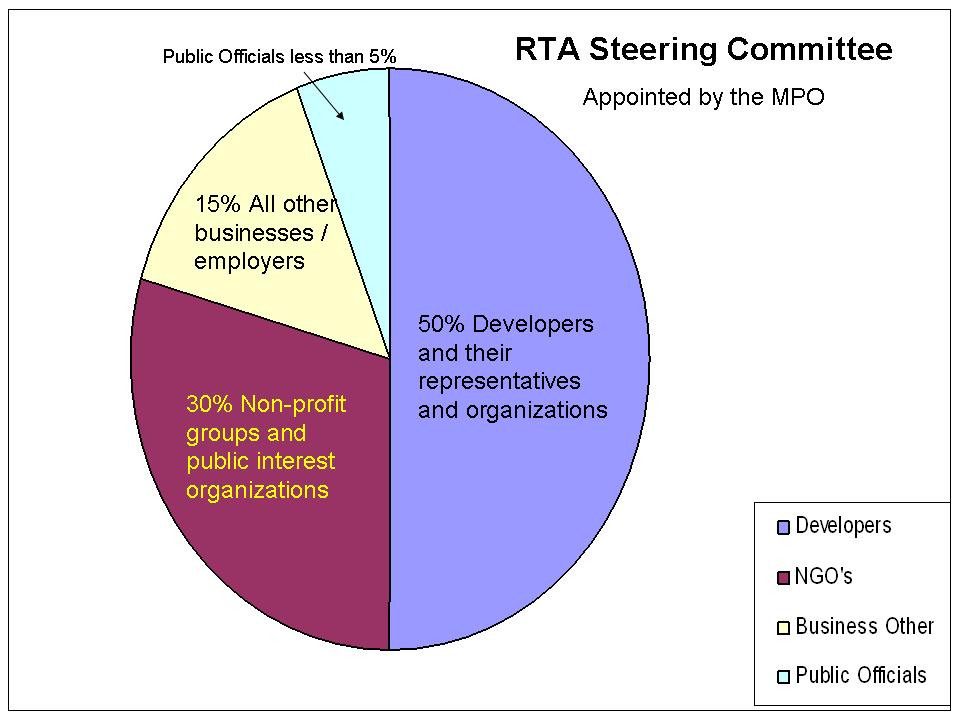
The RTA Principles Committee had been initiated with a conscious effort to have a “balanced� representation of
four interest groups (Business, Civic, Government and Environment/Public Interest), the MPO (Municipal Planning
Organization) Staff arbitrarily selected the members of the RTA likely as the result of heavy lobbying by the most
interested parties.
The RTA Steering Committee is comprised of 50% developers or their representatives with very few regular employers or
citizens represented in the process. Many of the participants were not participating out of civic responsibility but on behalf
of their employer to influence the process. While such private interests are indeed one part of the set of stakeholders,
allowing them to craft the proposal (as they did as a “majority� of those who eventually participated) set up an
inevitable conflict with both the Principles and the broad public interest they were supposed to represent.
Issues raised by the minority from the public interest community were routinely ignored or dismissed.
9. Development Fails To Pay Its Way
One Guiding Principle the RTA proposal fails to address is the idea that development must pay its own way. On the
contrary, the current proposal is to have area taxpayers far away from areas of new development pay for the
improvements the developer will require to build-out current properties.
10. The Proposal Fails to Provide Adequate Funding to Maintain New Roads
A key Guiding Principle ignored by the special interests on the RTA is the following,
“The transportation system of the region is an essential asset that must be maintained by allocating sufficient resources
in the most effective manner to keep it in sound operating condition.�
The RTA majority responsible for the proposal before the Loveland City Council is anticipating that municipalities will pay
the increased burden and cost that will come with maintaining the proposed transportation improvements. Loveland’s
City Council hasn’t necessarily planned for such increasing street maintenance and shouldn’t vote for the proposal
until they have identified where those additional funds will be coming from since the RTA proposal fails to provide any.
COMMENT ON THE BLOG BY CLICKING HERE
The proposal by the RTA Steering Committee does not match the Guiding Principles that were established prior to the
convening of the RTA Steering Committee. One defense provided for this is the fact the guiding principles were not
affirmed by the larger group of 34 members. However, the Steering Committee was never given the option of selecting
what part of their charter they wanted to ignore and that which they intended to follow.
2. Proposal Provides Subsidies To Private Developments / Proposes Loveland
Residents Pay Twice For Same Improvements
Approximately $38 Million of the proposed allocation would go to cover road improvement projects which are the direct
legal responsibility of the Centerra Metro District, under their Master Finance Agreement with the City of Loveland. That
agreement requires the developer to fund such projects as both Interim and “Ultimate� improvements for I-25/
US34 Interchange, the Crossroads Blvd interchange, and more.
Using new public taxes for those purposes means Loveland residents will be paying twice for the same improvements.
Seven of the twenty road improvements McWhinneys promised to accomplish with Loveland’s future sales tax
revenue will instead be paid for through the RTA tax increase. This is a huge windfall for the developer.
3. It forces local taxpayers to subsidize federal and state governments.
In placing a substantial portion of road capital allocations for I-25 Interchange improvements and for US34, the RTA
Proposal directly violates the 5th Principle: “[RTA] funds do not replace funds from the federal and state governments
and do not relieve them of their obligations to Northern Colorado.� Since locally-generated taxes would now be applied
to federal and state responsibilities, and since there is no mechanism for “pay back� of such expenditures, essentially
local taxpayers are subsidizing the state and federal governments.
RTA funds were meant to pay for critical regional transportation needs. As such these funds should not be used to replace
funds from the federal and state governments and should not relieve these governments of their obligations to Northern
Colorado. If accepted, the RTA proposal will take the unprecedented step of making local taxpayers cover the
responsibilities of both federal and state governments without any agreements or mechanics in place to insure such money
is repaid.
4. Regional Public Transit Portion of the Proposal has Fatal Flaws.
The success of intra- and inter-regional transit (i.e. city to city) is significantly dependent on how well the local (municipal)
transit system works. That is, if commuters can’t get to the “regional� connection station from home or office,
or can not get from it to their destination, i.e. via local public transit, then the regional service will not be effective or
successful.
This issue was identified early and often during the deliberations by the RTA Steering Committee. It is clear that some
communities (Greeley and especially Loveland) have very ineffective local transit operations where public participation is
very low. This means that FC-Loveland or Loveland-Greeley transit will likely remain ineffective also. The official RTA
proposal does not address this gap because it does not allocate any revenue for local transit improvements. While it does
not prohibit entities from using “Shareback� revenues for that purpose, this isn’t helpful. This is because in the
case of Loveland there will be little incentive or likelihood of Loveland’s use of shareback for local transit, given that
Loveland’s priorities are clearly larger roads to empty commercial lots owned or managed by Loveland Commercial
instead of improving public transportation by relieving existing congestion.
5. Proposal Already Rejected in Ft. Collins Due to Inequities – Financial
Assumptions No Longer Valid in the Current Proposal
The City of Fort Collins already rejected the proposal June 5, 2007 thus invalidating the financial assumptions being
presented to the City of Loveland that depends on getting money from Ft. Collins. Unless the Ft. Collins City Council
does an about-face and reverses its position, the voters of Ft. Collins will not even see the proposal on their November
ballot.
Even if one assumes that the road capital projects included “for� Fort Collins’ benefit are actually worthy of
new local sales tax (and in cases of fed/state responsibilities such as I-25 interchange improvements, that assumption is
especially questionable), Fort Collins is the big loser in the RTA, per separate cost-benefit analysis that compared relative
gains and losses among the various potential RTA participants. Total losses (in addition to any loss stemming from the use
of local tax dollars to fund a federal responsibility) are on the order of $66 Million.
6. The RTA Fails To Address Critical Traffic Problems While Making Others Worse
The same committee which drafted the Guiding Principles had begun with a statement of Problems to be addressed; i.e. a
rationale for the RTA.
Those defined problems, for example, included among others:
• rapid VMT growth;
• ozone non-attainment and other pollution threats;
• a rapidly aging population with mobility needs;
• insufficient maintenance of existing assets and funds for this; among others.
a. The process of creating the RTA Proposal did not include any review of how or whether various problems would be
addressed, or to what extent; and never looked at the effect of the proposal (in whole or part) on those problems.
Independent traffic modeling was not provided to give steering committee members information required to make these
decisions.
b. The Majority proposal spends the bulk of its money on road capacity expansion especially in areas not yet built-out.
This will likely increase VMT, and with it pollution (both ozone and particulates) lowering the area quality of life by
increasing undesirable increase in pollution.
c. The proposal provides little or no money for maintenance and in any case, expansion of roads (and VMT) will likely
exacerbate the maintenance deficit problem.
7. Could Be “One Bight at the Apple� Theory Is True by Precluding Future
Transportation Funding Due To Having Already Gone To Voters With Flawed
Proposal
The proposed 1cent sales tax (if shareback is included) represents a loss of tax “headroom� likely closing the door
on any other tax increase for any other purpose for the duration of the RTA tax period. This was acknowledged by
members of the RTA Steering Committee who said of the RTA “This is about being 1st in line at the cookie jar…once
we get ours no one else will get anything for many years.� Given that it is for questionable projects and circumstances
(a set of roads sought more by developers than by public), this could represents a huge “lost opportunity cost�.
Voters are unlikely to approve more funding for transportation if they realize the funding already passed went to areas of
FUTURE growth to help developers instead of addressing areas already over-burdened with traffic congestion.
8. Inherent Organizational Conflicts of Interests Allowed One Industry to Drive
Process.
The RTA Principles Committee had been initiated with a conscious effort to have a “balanced� representation of
four interest groups (Business, Civic, Government and Environment/Public Interest), the MPO (Municipal Planning
Organization) Staff arbitrarily selected the members of the RTA likely as the result of heavy lobbying by the most
interested parties.
The RTA Steering Committee is comprised of 50% developers or their representatives with very few regular employers or
citizens represented in the process. Many of the participants were not participating out of civic responsibility but on behalf
of their employer to influence the process. While such private interests are indeed one part of the set of stakeholders,
allowing them to craft the proposal (as they did as a “majority� of those who eventually participated) set up an
inevitable conflict with both the Principles and the broad public interest they were supposed to represent.
Issues raised by the minority from the public interest community were routinely ignored or dismissed.
9. Development Fails To Pay Its Way
One Guiding Principle the RTA proposal fails to address is the idea that development must pay its own way. On the
contrary, the current proposal is to have area taxpayers far away from areas of new development pay for the
improvements the developer will require to build-out current properties.
10. The Proposal Fails to Provide Adequate Funding to Maintain New Roads
A key Guiding Principle ignored by the special interests on the RTA is the following,
“The transportation system of the region is an essential asset that must be maintained by allocating sufficient resources
in the most effective manner to keep it in sound operating condition.�
The RTA majority responsible for the proposal before the Loveland City Council is anticipating that municipalities will pay
the increased burden and cost that will come with maintaining the proposed transportation improvements. Loveland’s
City Council hasn’t necessarily planned for such increasing street maintenance and shouldn’t vote for the proposal
until they have identified where those additional funds will be coming from since the RTA proposal fails to provide any.
COMMENT ON THE BLOG BY CLICKING HERE
| A Loveland Citizen's Guide to Understanding the RTA Proposal before Loveland City Council you can print this out and bring it to the City Council Meeting |
| List of Centerra Projects Loveland Taxpayers Are Being Asked to Fund A Second Time With Tax Dollars through the RTA Proposal |
| Typical Loveland City Council study session. No public comment is taken but the public does have the right to attend the meeting. |
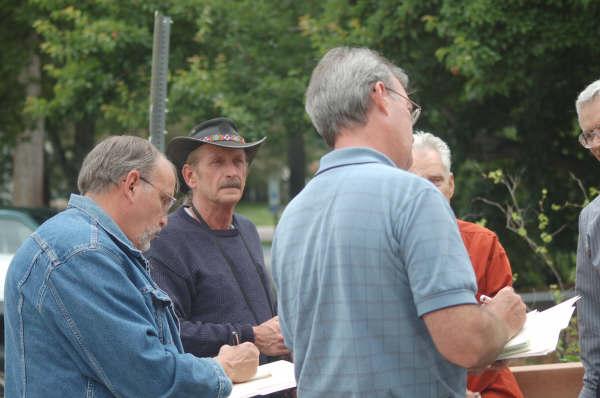
| Members of the RTA Steering Committee against the "Majority" proposal hold press conference in Ft. Collins June 12 |