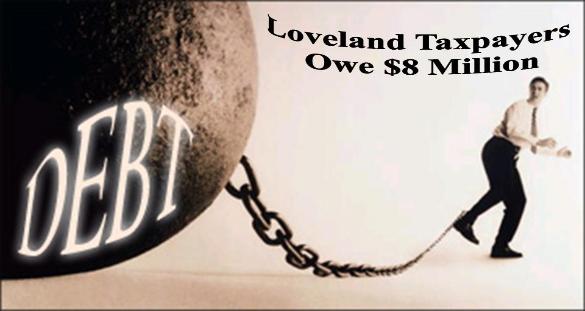
| Is the City of Loveland Hiding $8 Million in Debt? |
The City of Loveland has classified approximately $8 million owed to developers in
“oversizing� agreements as “contingent liabilities.� However, some
members of the citizen advisory committee for city finances are concerned.
Appointed by the City Council to oversee financial reporting and investments,
CFAC (Citizens Finance Advisory Committee) is asking staff to justify the curious
classification as “contingent liabilities� for the $8 million the city agreed to
pay developers out of the general fund.
Dave Clark and Walt Skowron, two Councilmen who serve as liaisons to CFAC,
were reported as trying to discourage the citizen members of the committee from
requesting detailed information from city staff regarding the debt by making the
claim there is no “contract� between the developers and the city but instead a
gentleman’s agreement. A common claim heard from Loveland’s City
Manager and Council has been that the city is “debt free.� It appears the $8
million owed to developers would contradict these assertions and put both the
Council and City Manager in a precarious position for having failed to properly
report debt they incurred on behalf of the city.
At the May 7, 2007 meeting, CFAC members asked city staff to bring back to the
committee details regarding the debt and an explanation of why it isn’t being
reported as debt in the public disclosures regarding city finances. The official
agenda for the meeting records the rebuttal by staff in the following way,
“The city has funded projected on a pay-as-you-go basis and, therefore, has no
official debt for transportation improvements but does have approximately $8 million
due to developers in the form of over-sizing reimbursement agreements. These
agreements acknowledge the value of improvements made by developers in excess of
the costs required for their developments but they do not contain any specific payment
terms. Payments have been made on these agreements based on amounts approved in
the annual budget process.�
According to a website designed to assist finance officers for public organizations,
the following is the definition of a contingent liability;
“A contingent liability is defined as an obligation relating to a past transaction or
event that may be payable in the future. The distinction between a real liability and a
contingent liability depends on the certainty of the payment to be made. A real
liability exists when it is probable that the payment will be made. A contingent
liability exists when it is only possible that the payment will be made.�
Sources close to the process reported to LovelandPolitics.com that city staff has
been doing some foot dragging at the behest of the City Manager, Don Williams,
who is concerned this issue could create, at the very least, an embarrassing problem
for the City of Loveland. Using the above definition, it appears the debt has been
improperly reported.
While specifics about the $8 million appear to be handled as “top secret� by
city staff, sources close to the situation informed LovelandPoliticscom that Don
Marostica’s company, Loveland Commercial, is among the companies that the
City of Loveland owes money. Marostica, now a State House Representative,
served as the Mayor Pro Tem of Loveland likely during a time when his company
was accumulating this “contingent liability� from the City of Loveland.
Loveland Commercial is also among the top two campaign contributors to
incumbents currently sitting on the City Council.
The debt appears to have resulted from a special program offered by the City of
Loveland where developers who “oversize� the required utilities for their
projects will receive a reimbursement from the city for 20% of their costs.
Questions have been raised in the past regarding the objectivity of the city in
determining what is 20% of their costs when some of the same developers are
themselves sitting on the City Council.
Unfortunately, the City of Loveland has admitted to failing in the past in
determining the proper use tax to charge local developers by using outdated
formulas and numbers causing some developers to under-pay their tax liabilities for
a number of years. The city finance department and city clerk have refused to
provide details of an audit that discovered these underpayments. They claim such
information is proprietary to the businesses impacted, however, sources to
LovelandPolitics.com from within the city report they are affraid of stirring
controversy among the developers themselves since some will pay their full use
taxes and others not. Absent an open and public process, those who paid more
could certainly claim unequal treatment under the law which has constitutional
implications.
The City Council was informed the city staff would “negotiate� with
companies that failed to pay all their use tax when projects were built and allow
them to pay some lesser amount on a case-by-case basis. There is no evidence the
city finance department used the unpaid use tax by some developers to off-set its
own financial liabilities (which appears more like debt) incurred with the developer
as the result of the City Council “reimbursement� policy.
In the meantime, members of the public may attend the CFAC committee meetings
(which are open to the public) and ask questions to the members of the committee
regarding their concerns on this topic. The meetings dates and times can be found
on the City of Loveland website.
“oversizing� agreements as “contingent liabilities.� However, some
members of the citizen advisory committee for city finances are concerned.
Appointed by the City Council to oversee financial reporting and investments,
CFAC (Citizens Finance Advisory Committee) is asking staff to justify the curious
classification as “contingent liabilities� for the $8 million the city agreed to
pay developers out of the general fund.
Dave Clark and Walt Skowron, two Councilmen who serve as liaisons to CFAC,
were reported as trying to discourage the citizen members of the committee from
requesting detailed information from city staff regarding the debt by making the
claim there is no “contract� between the developers and the city but instead a
gentleman’s agreement. A common claim heard from Loveland’s City
Manager and Council has been that the city is “debt free.� It appears the $8
million owed to developers would contradict these assertions and put both the
Council and City Manager in a precarious position for having failed to properly
report debt they incurred on behalf of the city.
At the May 7, 2007 meeting, CFAC members asked city staff to bring back to the
committee details regarding the debt and an explanation of why it isn’t being
reported as debt in the public disclosures regarding city finances. The official
agenda for the meeting records the rebuttal by staff in the following way,
“The city has funded projected on a pay-as-you-go basis and, therefore, has no
official debt for transportation improvements but does have approximately $8 million
due to developers in the form of over-sizing reimbursement agreements. These
agreements acknowledge the value of improvements made by developers in excess of
the costs required for their developments but they do not contain any specific payment
terms. Payments have been made on these agreements based on amounts approved in
the annual budget process.�
According to a website designed to assist finance officers for public organizations,
the following is the definition of a contingent liability;
“A contingent liability is defined as an obligation relating to a past transaction or
event that may be payable in the future. The distinction between a real liability and a
contingent liability depends on the certainty of the payment to be made. A real
liability exists when it is probable that the payment will be made. A contingent
liability exists when it is only possible that the payment will be made.�
Sources close to the process reported to LovelandPolitics.com that city staff has
been doing some foot dragging at the behest of the City Manager, Don Williams,
who is concerned this issue could create, at the very least, an embarrassing problem
for the City of Loveland. Using the above definition, it appears the debt has been
improperly reported.
While specifics about the $8 million appear to be handled as “top secret� by
city staff, sources close to the situation informed LovelandPoliticscom that Don
Marostica’s company, Loveland Commercial, is among the companies that the
City of Loveland owes money. Marostica, now a State House Representative,
served as the Mayor Pro Tem of Loveland likely during a time when his company
was accumulating this “contingent liability� from the City of Loveland.
Loveland Commercial is also among the top two campaign contributors to
incumbents currently sitting on the City Council.
The debt appears to have resulted from a special program offered by the City of
Loveland where developers who “oversize� the required utilities for their
projects will receive a reimbursement from the city for 20% of their costs.
Questions have been raised in the past regarding the objectivity of the city in
determining what is 20% of their costs when some of the same developers are
themselves sitting on the City Council.
Unfortunately, the City of Loveland has admitted to failing in the past in
determining the proper use tax to charge local developers by using outdated
formulas and numbers causing some developers to under-pay their tax liabilities for
a number of years. The city finance department and city clerk have refused to
provide details of an audit that discovered these underpayments. They claim such
information is proprietary to the businesses impacted, however, sources to
LovelandPolitics.com from within the city report they are affraid of stirring
controversy among the developers themselves since some will pay their full use
taxes and others not. Absent an open and public process, those who paid more
could certainly claim unequal treatment under the law which has constitutional
implications.
The City Council was informed the city staff would “negotiate� with
companies that failed to pay all their use tax when projects were built and allow
them to pay some lesser amount on a case-by-case basis. There is no evidence the
city finance department used the unpaid use tax by some developers to off-set its
own financial liabilities (which appears more like debt) incurred with the developer
as the result of the City Council “reimbursement� policy.
In the meantime, members of the public may attend the CFAC committee meetings
(which are open to the public) and ask questions to the members of the committee
regarding their concerns on this topic. The meetings dates and times can be found
on the City of Loveland website.
LovelandPolitics.com