| LovelandPolitics.com |

| Crowd Confronts City Council Over Train Whistle Noise Federal Official Says City Estimate "Excessive" For Fixing Problem |
Loveland - July 2, 2008
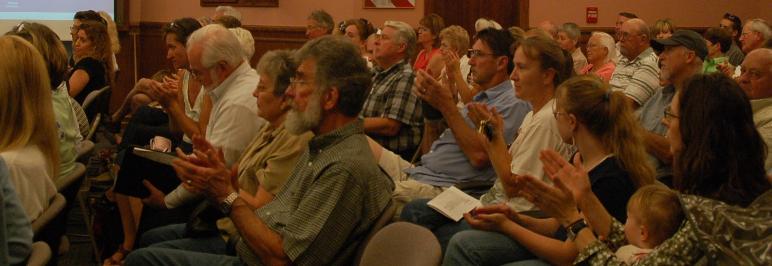
The Loveland city council chamber was standing room only while residents angry over the noise of trains
packed the council chamber to find out what their city is willing to do to fix the problem.
The Problem
In June of 2005 the Federal Railroad Administration (FRA) determined that all trains must sound their horn at
substandard crossings in urban areas to avoid collisions with automobiles or pedestrians. In addition, the
train horns have become louder in recent years now blowing out between 90 to 110 decibels -- well over the
city's noise ordinance maximum allowed. Click here to see the FRA website, rule making history and the
analysis and reports.
Train engineers are required to sound their horn for a minimum of 15 seconds and a maximum of 20 seconds
approximately 1/4 mile before the crossing depending on the speed of the train and continue until the train
enters the crossing. As the Department of Transportation step-up enforcement of this rule it means
Loveland's residents endure 7 to 10 trains per day each blowing their horns for the fourteen different at
grade crossings in Loveland throughout the day and night. The residents who live near the crossings have
been awakened in their homes in the middle of the night by the louder and now more frequent noise caused
by trains passing through Loveland.
The Solution - Railroad Says City is Overstating Costs
Establishing Quiet Zones
The horn rule does not apply to cities that are determined to be "quiet zones" where the safety at the existing
crossings is adequate enough the engineer doesn't need to blow the horn. This is because the train horn rule
is based on a complicated formula regarding the acceptable standard or risk allowed at any specific crossing.
Therefore, an upgrade in Loveland's crossings could qualify Loveland to be a quiet zone where the engineers
are not required to blow their horns.
According to the FRA,
Loveland's Director of Public Works, Keith Reester, informed the City Council the cost of making the
necessary improvements to existing crossings to qualify as a quiet zone is $4.25 Million. The Loveland
Reporter-Herald ran a headline stating "Cost of quiet zones: $4.25M." However, Reester's memorandum
estimated the cost of building 7 quad-gates crossings and improving older existing gates. These estimates
were based on a cursory review of the existing crossings but even Reester's memorandum to the council
suggested a detailed analysis is required before understanding what improvements will need to be done to
qualify as a quiet zone.
Warren Flatau, Senior Public Affairs Specialist of the FRA, in Washington, D.C. told LovelandPolitics in a phone
interview "The quad gates or horns are not necessarily required to be a quite zone" he went on to say this is a
common myth that is often purported in local community forums. "When we hear private citizens, the local
media or local officials claim four quad gates are required along with other improvements to get a quiet zone
crossing designation it is often because they want to over-state the case and artificially inflate the costs."
Attached is a short fact-sheet regarding quiet zones Mr. Flatau provided LovelandPolitics to set the record
straight.
Flatau also stated that quad crossings are the "gold-standard" for which applications for quiet zones can
seldom if ever be denied. He indicated this is a common "first-look" at an intersection that may require center
curbing (which prevents traffic from going around existing gates) or flashing lights instead of the more
expensive solutions. Reester, in a telephone interview with LovelandPolitics July 2, stated, "we looked at those
intersections and curbs won't work there..." Reester also pointed to the crossing near the new Walmart
where he didn't project a need for the quad gates but suggested the growing traffic in the area means they
will be required sometime in the future. Reester also indicated his department will be continuing to look at
the proposed changes to see if there are "best practices" that can be used to reduce the overall $4.5 million
estimate.
City Council Comments / Action
Members of the City Council encouraged the audience to contact their federal representatives to try and
remedy the problem and Councilman Walt Skowron said several times that in an election year they should be
more responsive. Skowron also stated, "I am impressed by the number here." Mayor Gene Pielin stated, "I do
appreciate how many people are here" but also tried to pass the buck onto the federal government as the
responsible party.
The council failed to provide any direction to staff to bring back an appropriation item in the future so they
could begin the multi-year process of updating Loveland's at grade crossings in anticipation of becoming a
quiet zone. A number of residents in the audience were disappointed the council "punted" the issue. It was
pointed out that the majority of this council was willing to appropriate well over $4 million at the drop of a hat
to subsidize more annexations along the I-25. As one resident stated, "it is our money, why can't they spend
it to preserve our quality of life while making everyone else in town safe when crossing the tracks - it seems
like a no brainer too me."
The Loveland city council chamber was standing room only while residents angry over the noise of trains
packed the council chamber to find out what their city is willing to do to fix the problem.
The Problem
In June of 2005 the Federal Railroad Administration (FRA) determined that all trains must sound their horn at
substandard crossings in urban areas to avoid collisions with automobiles or pedestrians. In addition, the
train horns have become louder in recent years now blowing out between 90 to 110 decibels -- well over the
city's noise ordinance maximum allowed. Click here to see the FRA website, rule making history and the
analysis and reports.
Train engineers are required to sound their horn for a minimum of 15 seconds and a maximum of 20 seconds
approximately 1/4 mile before the crossing depending on the speed of the train and continue until the train
enters the crossing. As the Department of Transportation step-up enforcement of this rule it means
Loveland's residents endure 7 to 10 trains per day each blowing their horns for the fourteen different at
grade crossings in Loveland throughout the day and night. The residents who live near the crossings have
been awakened in their homes in the middle of the night by the louder and now more frequent noise caused
by trains passing through Loveland.
The Solution - Railroad Says City is Overstating Costs
Establishing Quiet Zones
The horn rule does not apply to cities that are determined to be "quiet zones" where the safety at the existing
crossings is adequate enough the engineer doesn't need to blow the horn. This is because the train horn rule
is based on a complicated formula regarding the acceptable standard or risk allowed at any specific crossing.
Therefore, an upgrade in Loveland's crossings could qualify Loveland to be a quiet zone where the engineers
are not required to blow their horns.
According to the FRA,
- "Once all necessary safety engineering improvements are made, the local community must certify
to FRA that the required level of risk reduction has been achieved. A quiet zone becomes effective
and train horns go silent only when all necessary additional safety measures are installed and
operational."
Loveland's Director of Public Works, Keith Reester, informed the City Council the cost of making the
necessary improvements to existing crossings to qualify as a quiet zone is $4.25 Million. The Loveland
Reporter-Herald ran a headline stating "Cost of quiet zones: $4.25M." However, Reester's memorandum
estimated the cost of building 7 quad-gates crossings and improving older existing gates. These estimates
were based on a cursory review of the existing crossings but even Reester's memorandum to the council
suggested a detailed analysis is required before understanding what improvements will need to be done to
qualify as a quiet zone.
Warren Flatau, Senior Public Affairs Specialist of the FRA, in Washington, D.C. told LovelandPolitics in a phone
interview "The quad gates or horns are not necessarily required to be a quite zone" he went on to say this is a
common myth that is often purported in local community forums. "When we hear private citizens, the local
media or local officials claim four quad gates are required along with other improvements to get a quiet zone
crossing designation it is often because they want to over-state the case and artificially inflate the costs."
Attached is a short fact-sheet regarding quiet zones Mr. Flatau provided LovelandPolitics to set the record
straight.
Flatau also stated that quad crossings are the "gold-standard" for which applications for quiet zones can
seldom if ever be denied. He indicated this is a common "first-look" at an intersection that may require center
curbing (which prevents traffic from going around existing gates) or flashing lights instead of the more
expensive solutions. Reester, in a telephone interview with LovelandPolitics July 2, stated, "we looked at those
intersections and curbs won't work there..." Reester also pointed to the crossing near the new Walmart
where he didn't project a need for the quad gates but suggested the growing traffic in the area means they
will be required sometime in the future. Reester also indicated his department will be continuing to look at
the proposed changes to see if there are "best practices" that can be used to reduce the overall $4.5 million
estimate.
City Council Comments / Action
Members of the City Council encouraged the audience to contact their federal representatives to try and
remedy the problem and Councilman Walt Skowron said several times that in an election year they should be
more responsive. Skowron also stated, "I am impressed by the number here." Mayor Gene Pielin stated, "I do
appreciate how many people are here" but also tried to pass the buck onto the federal government as the
responsible party.
The council failed to provide any direction to staff to bring back an appropriation item in the future so they
could begin the multi-year process of updating Loveland's at grade crossings in anticipation of becoming a
quiet zone. A number of residents in the audience were disappointed the council "punted" the issue. It was
pointed out that the majority of this council was willing to appropriate well over $4 million at the drop of a hat
to subsidize more annexations along the I-25. As one resident stated, "it is our money, why can't they spend
it to preserve our quality of life while making everyone else in town safe when crossing the tracks - it seems
like a no brainer too me."

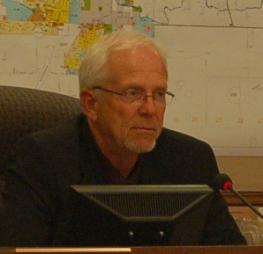
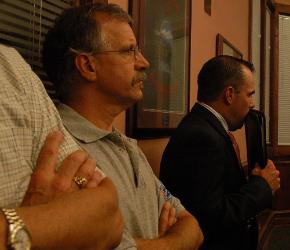
| Keith Reester, Director of Public Works, City of Loveland |
| Mayor Pielin joked the trains in Ft. Collins could be raced and recognized the large number of residents concerned about this issue. |

| These "quad gates" and flashers (left) are considered the safest barrier to traffic for trains as cars cannot wind through them when they don't see the train coming. The railroad crossings in Loveland proposed to receive the quad gates according to Reester's memo would be 1st at Railroad Ave, 4th at Railroad Ave, 6th at Railroad Ave, 7th at Railroad Ave, 10th at Railroad 29th Street and Lakecrest Place. Garfield and 22nd would receive a 6 gate crossing. Intersections not proposed for quad gates in the cost estimate are County Road 16 at Roosevelt, 14th Street at Roosevelt, 37th near Butternut |