| LovelandPolitics.com |

| McWhinney's Centerra Fights Promenade Partner Poag & McEwen In Court Local Media Missed Story Behind Property Foreclosure and Value Dispute |
Loveland - March 17, 2010
The delayed foreclosure auction of the Promenade Shops at Centerra until mid-April has sparked
rumors that McWhinney (a current owner) gathered a group of investors to buy the property out of
foreclosure for an amount less than the current loan of $112,861,606. However, the impact a
transfer of the Promenade shops to another owner (through foreclosure or short sale) creates other
problems for McWhinney's Centerra Metro District not yet explored or reported on in the local
media.
This is due to the fact that a significantly reduced value of the property would plummet property tax
revenue required to payback the $112 million in municipal public bond debt separate from the loan
now in foreclosure.
The Centerra Metro District relies on two primary revenue sources to repay the public bonds used to
subsidize much of Centerra:
1. Property tax collections
a) 98.8% Urban Renewal kickback of property taxes paid each year
b) The Centerra Metro District #2 Mill Levy
2. Sales Taxes (called fees but collected just like a sales tax)
a) 40% rebate of Loveland sales tax - called a PIF and charged at 1.25% on retail sales
b) 1% extra McWhinney tax collected at point of sale
Click here for details on Centerra sales taxes
A dip in the values of Centerra properties in general caused by either the Promenade foreclosure
action or a successful abatement and refund of previous year's property taxes could spell trouble for
the already lean Centerra Metro District. Reducing property tax revenue to the District means it will
be harder for Centerra to satisfy its growing bond debt payment obligations. The annual cost of the
debt will increase to $7 million by 2012 and exceed $8 million in another 7 years. Therefore,
Centerra needs increasing revenue sources to repay the public bond debt..
Centerra Sues McWhinney Business Partner Over Promenade Property Tax Appeal
Poag & McEwen, the managing partner of the Promenade Shops at Centerra, has learned that
sometimes a dispute with your business partner can be the same as fighting city hall when your
partner is McWhinney. This is because McWhinney has the ability to direct public resources from the
Centerra Metro District to their benefit..
Poag & McEwen protested the 2008 Larimer County appraised value for parcel number 8510113001
of $81 million which includes most of the Promenade Shops and movie theater but not Macey’s or
Dick’s Sporting Goods buildings. In addition, Poag & McEwen initiated an abatement for taxes paid in
2007 based on value calculations of the same property which is a type of appeal against taxes
already paid and settled.
Poag & McEwen, like any good business operator, likely wanted to reduce their overhead costs at the
Promenade Shops at Centerra by reducing the amount in property taxes they were required to pay.
They protested the estimated property values by the Larimer County Assessor's appraisal of the
commercial property. What they didn't count on was that their partner in the Promenade Shops,
McWhinney, had their own pecuniary interests to protect and instead of assisting the protest actually
opposed it.
That is because most of the property taxes collected in Centerra are diverted to McWhinney’s quasi-
government local Centerra Metro District through the Loveland Urban Renewal Authority. Larimer
County is obligated to kickback 98.8% of the property taxes collected from Promenade Shops at
Centerra on behalf of schools and local governments to the Urban Renewal Authority which in-turn
supplies most of the funds to Centerra. (refer to insert box on right for details).
The Centerra Metro District, which is operated largely by McWhinney, filed a motion to dismiss Poag
& McEwen's 2007 and 2008 property tax appeal by summary judgement in district court. Having the
quasi-governmental entity file the motion means McWhinney could litigate the matter against their
partner in Promenade Shops, Poag & McEwen, by using public tax dollars and the public entity as
their club.
According to sources close to McWhinney, Centerra is claiming Poag & McEwen cannot protest the
property taxes for two reasons. One is that Poag & McEwen doesn’t have standing to appeal the
county's tax assessment unless McWhinney, the other owner/partner, agrees to the protest -- which
they don’t. This argument is especially ironic given that, in statements to the press, in which they
distanced themselves from the Promenade Shops at Centerra foreclosure, McWhinney stated that
they were merely "a silent partner in the development deal" and that "Poag & McEwen is
responsible for overseeing financial issues." See story on foreclosure
Centerra's second argument raised during the appeal process at the county level and likely being
used in the litigation is the claim that Poag & McEwen agreed not to appeal property tax valuations.
Poag & McEwen have argued this is not correct.
Larimer County denied the protests and appeals by the Promenade Shops regarding their 2008
property taxes and abatement of their 2007 property taxes. After numerous hearings at the county
level regarding the protest, Poag & McEwen exercised their right to appeal beyond the county
authorities and seek relief from the State of Colorado. Poag & McEwen’s property tax appeal is now
before the State’s Board of Assessment and Appeals (BAA).
In 2005 the BAA granted a similar appeal to the Colorado Mills shopping Mall thus adjusting
downward the assessed value from approximately $150,000,000 to $126,000,000. Larimer County
sources tell LovelandPolitics that the claimed commercial value of the Promenade Shops by Poag &
McEwen "are a joke it is so low." If Poag & McEwen were to succeed or a subsequent owner in
achieving a sharp decrease in valuation for assessment than the Metro District would likely be in
trouble.
In the meantime, the foreclosure on the outstanding private loan balance of $112,861,606.23 for
Promenade Shops has caused the property tax appeal to be referred to the Denver law firm handling
the foreclosure. Acting as the receiver of the property; the law firm of Markus,Williams, Young &
Zimmermann has not cancelled the appeal. Instead, sources told Lovelandpolitics.com the law firm
has suspended the current appeal to the BAA until a new owner is identified after foreclosure or
until August 31, whichever comes first. In other words, both Poag & McEwen and their formerly
silent partner, McWhinney, on the Promenade Shops have no standing if they will soon be losing the
property to foreclosure as any rebate in taxes only goes to current and not past owners.
Millions In Diverted Revenue
Under urban renewal, developers are allowed to use Tax Increment Financing (TIF), which means
they get to keep the property tax increment - the difference between taxes on the pre-existing value
of land and the that of the "improved" property. Thus, any improvement in the value of the Centerra
properties results in significant revenues - 98.8% of the property taxes collected - to the Centerra
Metro District each year. (refer to chart on inset to the right).
Larimer County's December 2009 assessment of the Centerra properties inside the Urban Renewal
area resulted in an assessed valuation of $98,889,441.
The Promenade Shops at Centerra account for a significant portion of the value of property from
Centerra in the renewal area. If the dramatic reduction in actual property value is granted by BAA, as
sought by Poag & McEwen, or any subsequent owner resulting from foreclosure, the Centerra Metro
District could lose enough revenue to become delinquent on their bond debt payments.
Excluding the Centerra Metro District Mill Levy, other local governments would normally receive
around $7 million annually on the commercial assessed valuation of Centerra properties in
Loveland's Urban Renewal area. Instead, 98.8% of the money collected on the nearly $99 million
assessment is rebated at year’s end by the Larimer County Treasurer to Loveland's Urban Renewal
Authority which rebates most of it to McWhinney’s Centerra Metro District.
As an example, the estimated $3.8 million in property taxes collected annually by the county on
behalf of the Thompson RJ-2 school district's Mill Levy of 41.295 is diverted to McWhinney's Metro
District. After the county provides the Centerra kickback, Thompson RJ-2 receives only $46,286 of
the $3.8 million collected by the county on the education Mill Levy from Promenade Shops at
Centerra and the Market Place at Centerra retail and commercial properties. However, some money
does flow to the school district from the Centerra Metro District per agreements made with the
school district. In 2004 the city projected the school district would lose approximately $88 million
when expanding the Urban Renewal plan to Centerra in future taxes as a result of the tax diversion.
In exchange for receiving the school district's projected $88 million in future Mill Levy payments for
25 years, Centerra agreed to refund some $12 million under certain circumstances to the district by
way of property for a charter school and other considerations.
Medical Center of The Rockies - Centerra Metro District Owes $60,000
The Medical Center of the Rockies received an exemption from the State of Colorado for 97% of their
property taxes a few years ago thus dropping the assessed valuation from approximately $85 million
to $6 million.
Than the hospital requested an abatement of the 2008 property taxes they paid which was granted
by the Larimer County Assessor. This means the county must now collect the overpaid taxes back
from the various taxing authorities. Thompson RJ-2 and Centerra Metro District #2 must now
provide the Medical Center a refund from the 2008 taxes they received.
The delayed foreclosure auction of the Promenade Shops at Centerra until mid-April has sparked
rumors that McWhinney (a current owner) gathered a group of investors to buy the property out of
foreclosure for an amount less than the current loan of $112,861,606. However, the impact a
transfer of the Promenade shops to another owner (through foreclosure or short sale) creates other
problems for McWhinney's Centerra Metro District not yet explored or reported on in the local
media.
This is due to the fact that a significantly reduced value of the property would plummet property tax
revenue required to payback the $112 million in municipal public bond debt separate from the loan
now in foreclosure.
The Centerra Metro District relies on two primary revenue sources to repay the public bonds used to
subsidize much of Centerra:
1. Property tax collections
a) 98.8% Urban Renewal kickback of property taxes paid each year
b) The Centerra Metro District #2 Mill Levy
2. Sales Taxes (called fees but collected just like a sales tax)
a) 40% rebate of Loveland sales tax - called a PIF and charged at 1.25% on retail sales
b) 1% extra McWhinney tax collected at point of sale
Click here for details on Centerra sales taxes
A dip in the values of Centerra properties in general caused by either the Promenade foreclosure
action or a successful abatement and refund of previous year's property taxes could spell trouble for
the already lean Centerra Metro District. Reducing property tax revenue to the District means it will
be harder for Centerra to satisfy its growing bond debt payment obligations. The annual cost of the
debt will increase to $7 million by 2012 and exceed $8 million in another 7 years. Therefore,
Centerra needs increasing revenue sources to repay the public bond debt..
Centerra Sues McWhinney Business Partner Over Promenade Property Tax Appeal
Poag & McEwen, the managing partner of the Promenade Shops at Centerra, has learned that
sometimes a dispute with your business partner can be the same as fighting city hall when your
partner is McWhinney. This is because McWhinney has the ability to direct public resources from the
Centerra Metro District to their benefit..
Poag & McEwen protested the 2008 Larimer County appraised value for parcel number 8510113001
of $81 million which includes most of the Promenade Shops and movie theater but not Macey’s or
Dick’s Sporting Goods buildings. In addition, Poag & McEwen initiated an abatement for taxes paid in
2007 based on value calculations of the same property which is a type of appeal against taxes
already paid and settled.
Poag & McEwen, like any good business operator, likely wanted to reduce their overhead costs at the
Promenade Shops at Centerra by reducing the amount in property taxes they were required to pay.
They protested the estimated property values by the Larimer County Assessor's appraisal of the
commercial property. What they didn't count on was that their partner in the Promenade Shops,
McWhinney, had their own pecuniary interests to protect and instead of assisting the protest actually
opposed it.
That is because most of the property taxes collected in Centerra are diverted to McWhinney’s quasi-
government local Centerra Metro District through the Loveland Urban Renewal Authority. Larimer
County is obligated to kickback 98.8% of the property taxes collected from Promenade Shops at
Centerra on behalf of schools and local governments to the Urban Renewal Authority which in-turn
supplies most of the funds to Centerra. (refer to insert box on right for details).
The Centerra Metro District, which is operated largely by McWhinney, filed a motion to dismiss Poag
& McEwen's 2007 and 2008 property tax appeal by summary judgement in district court. Having the
quasi-governmental entity file the motion means McWhinney could litigate the matter against their
partner in Promenade Shops, Poag & McEwen, by using public tax dollars and the public entity as
their club.
According to sources close to McWhinney, Centerra is claiming Poag & McEwen cannot protest the
property taxes for two reasons. One is that Poag & McEwen doesn’t have standing to appeal the
county's tax assessment unless McWhinney, the other owner/partner, agrees to the protest -- which
they don’t. This argument is especially ironic given that, in statements to the press, in which they
distanced themselves from the Promenade Shops at Centerra foreclosure, McWhinney stated that
they were merely "a silent partner in the development deal" and that "Poag & McEwen is
responsible for overseeing financial issues." See story on foreclosure
Centerra's second argument raised during the appeal process at the county level and likely being
used in the litigation is the claim that Poag & McEwen agreed not to appeal property tax valuations.
Poag & McEwen have argued this is not correct.
Larimer County denied the protests and appeals by the Promenade Shops regarding their 2008
property taxes and abatement of their 2007 property taxes. After numerous hearings at the county
level regarding the protest, Poag & McEwen exercised their right to appeal beyond the county
authorities and seek relief from the State of Colorado. Poag & McEwen’s property tax appeal is now
before the State’s Board of Assessment and Appeals (BAA).
In 2005 the BAA granted a similar appeal to the Colorado Mills shopping Mall thus adjusting
downward the assessed value from approximately $150,000,000 to $126,000,000. Larimer County
sources tell LovelandPolitics that the claimed commercial value of the Promenade Shops by Poag &
McEwen "are a joke it is so low." If Poag & McEwen were to succeed or a subsequent owner in
achieving a sharp decrease in valuation for assessment than the Metro District would likely be in
trouble.
In the meantime, the foreclosure on the outstanding private loan balance of $112,861,606.23 for
Promenade Shops has caused the property tax appeal to be referred to the Denver law firm handling
the foreclosure. Acting as the receiver of the property; the law firm of Markus,Williams, Young &
Zimmermann has not cancelled the appeal. Instead, sources told Lovelandpolitics.com the law firm
has suspended the current appeal to the BAA until a new owner is identified after foreclosure or
until August 31, whichever comes first. In other words, both Poag & McEwen and their formerly
silent partner, McWhinney, on the Promenade Shops have no standing if they will soon be losing the
property to foreclosure as any rebate in taxes only goes to current and not past owners.
Millions In Diverted Revenue
Under urban renewal, developers are allowed to use Tax Increment Financing (TIF), which means
they get to keep the property tax increment - the difference between taxes on the pre-existing value
of land and the that of the "improved" property. Thus, any improvement in the value of the Centerra
properties results in significant revenues - 98.8% of the property taxes collected - to the Centerra
Metro District each year. (refer to chart on inset to the right).
Larimer County's December 2009 assessment of the Centerra properties inside the Urban Renewal
area resulted in an assessed valuation of $98,889,441.
The Promenade Shops at Centerra account for a significant portion of the value of property from
Centerra in the renewal area. If the dramatic reduction in actual property value is granted by BAA, as
sought by Poag & McEwen, or any subsequent owner resulting from foreclosure, the Centerra Metro
District could lose enough revenue to become delinquent on their bond debt payments.
Excluding the Centerra Metro District Mill Levy, other local governments would normally receive
around $7 million annually on the commercial assessed valuation of Centerra properties in
Loveland's Urban Renewal area. Instead, 98.8% of the money collected on the nearly $99 million
assessment is rebated at year’s end by the Larimer County Treasurer to Loveland's Urban Renewal
Authority which rebates most of it to McWhinney’s Centerra Metro District.
As an example, the estimated $3.8 million in property taxes collected annually by the county on
behalf of the Thompson RJ-2 school district's Mill Levy of 41.295 is diverted to McWhinney's Metro
District. After the county provides the Centerra kickback, Thompson RJ-2 receives only $46,286 of
the $3.8 million collected by the county on the education Mill Levy from Promenade Shops at
Centerra and the Market Place at Centerra retail and commercial properties. However, some money
does flow to the school district from the Centerra Metro District per agreements made with the
school district. In 2004 the city projected the school district would lose approximately $88 million
when expanding the Urban Renewal plan to Centerra in future taxes as a result of the tax diversion.
In exchange for receiving the school district's projected $88 million in future Mill Levy payments for
25 years, Centerra agreed to refund some $12 million under certain circumstances to the district by
way of property for a charter school and other considerations.
Medical Center of The Rockies - Centerra Metro District Owes $60,000
The Medical Center of the Rockies received an exemption from the State of Colorado for 97% of their
property taxes a few years ago thus dropping the assessed valuation from approximately $85 million
to $6 million.
Than the hospital requested an abatement of the 2008 property taxes they paid which was granted
by the Larimer County Assessor. This means the county must now collect the overpaid taxes back
from the various taxing authorities. Thompson RJ-2 and Centerra Metro District #2 must now
provide the Medical Center a refund from the 2008 taxes they received.
| Centerra's Property Tax Kickback On January 20, 2004 the Loveland City Council passed a resolution placing 1,300 acres of commercial property in McWhinney's 3,000 acre Centerra development area into Loveland's Urban Renewal Authority thus diverting future property taxes for 25 years back to McWhinney's Metro District. Called the US 34/Crossroads Corridor Renewal Plan it didn't receive as much media attention as the diversion of future sales taxes dollars that was also passed that night as part of the Master Financing Agreement (MFA) between Loveland and McWhinney. Click here to read LovelandPolitics story on the sales taxes. As a result, the Larimer County Treasurer now sends Centerra a kickback each year of approximately 98.8% of all property taxes collected in Centerra's "Renewal Plan area" which includes the Promenade Shops which ironically really is a distressed property now in 2010 due to McWhinney's risky financing schemes. McWhinney's Centerra Metro Districts' property tax kickback includes property taxes collected from property owners using the following Mills; Thomspon RJ-2 School District (Mill Levy of 41.295) Larimer County (Mill Levy of 22.435) City of Loveland (Mill Levy of 9.564) Thompson Valley Health Services (Mill Levy of 2.093) Larimer County Pest Control (Mill Levy of .142 N. Col. Water Conservation Dist. (Mill Levy of 1) Property tax owed is calculated by multiplying the property's assessed value* against the Mill Levy and than dividing by 1,000. (Assessed Value x Mill Levy / 1,000) By the numbers: Assessed Value of Centerra Properties Inside The Urban Renewal Authority: $93, 889,441 (100%) Maximum Assessed Value Taxes Can Be Kept On By Local Government Agencies $1,133,947 (1.2%) Result: Centerra Metro District gets an annual kickback from the Larimer County Treasurer of 98.8% of the property taxes collected from property owners inside the renewal area. * Assessed value means the amount of value taxed. In Larimer County it is 29% of the actual value for vacant land and commercial properties but 7.96% for residential. |
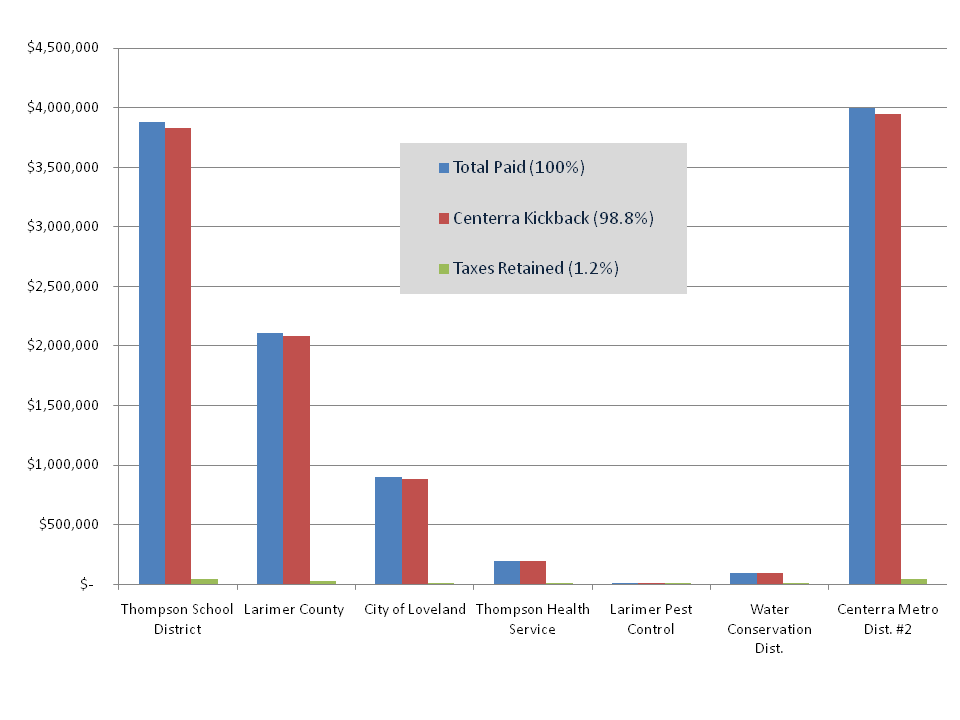
| Click on the image above to see how much of the property taxes collected in Centerra's Urban Renewal Authority area are sent back to the Metro District via the Urban Renewal Authority instead of funding local agencies and governments. |