| LovelandPolitics.com |

| McWhinney Flouts Loveland Campaign Finance Reform Is The Legitimacy of Loveland's City Charter Being Tested? |
Loveland - December 6, 2009
In the final stretch of the recent Loveland municipal elections, a McWhinney
senior employee along with a consultant and attorney jumped-in to
contribute the maximum contribution of $100 each to three select candidates
for mayor and city council.
Last minute or post election contributions allow candidates the luxury of
reporting the contributor's name after the election has ended. Because
candidates can also lend money to their own campaigns, they often lend
themselves money during the campaign that can be reimbursed by
controversial donors after the election has ended to avoid the political
damage that may have resulted from taking such contributions.
If this was all that occurred in Loveland's November 2009 election the story
might only reveal sneaky political maneuvering but not anything more
serious. However, McWhinney apparently decided to take their
involvement one step further and began writing checks from various limited
liability companies (LLC) controlled by McWhinney to candidates as they
did before Loveland's campaign finance reform Measure 2C was passed by
Loveland voters to stop these practices. Measure 2C was a campaign
finance reform measure placed on Loveland's ballot in 2006 by Lovelanders
for Fair Elections. The language of the initiative is now part the Loveland
City Charter which makes it part of the city's laws.
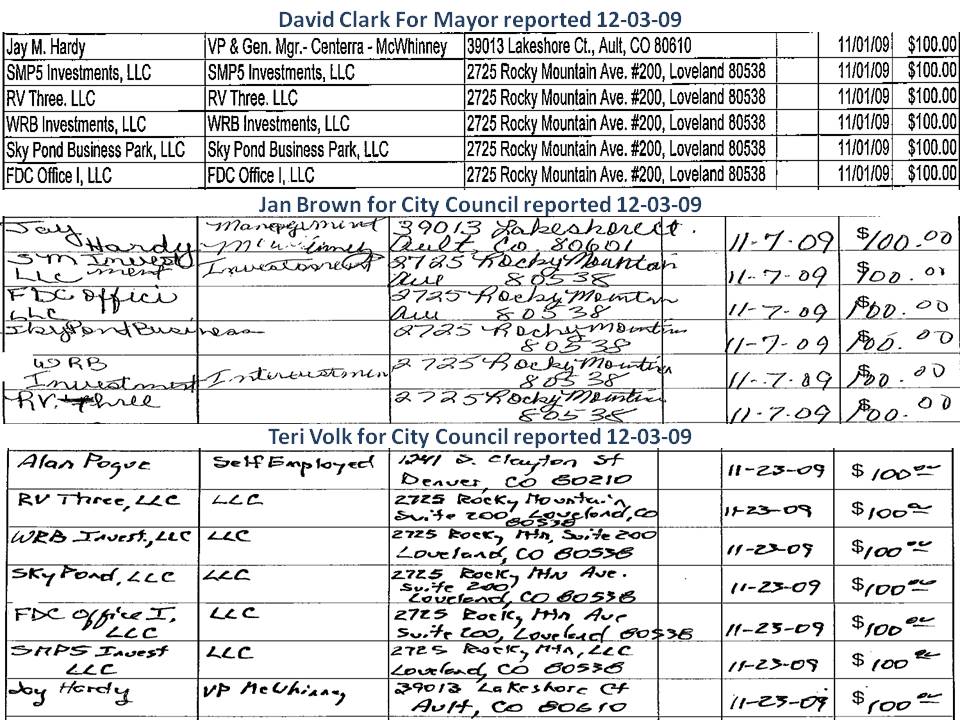
Failed mayoral candidate David Clark reported receiving some $500 from
McWhinney staff or controlled companies two days before the November 3,
2009 election while council candidate Jan Brown reported the same $500 in
contributions from the same entities but four days after the election while
council candidate Teri Volk reported similar contributions were received all
on November 23, 2009. (see graphic on the right)
In the final stretch of the recent Loveland municipal elections, a McWhinney
senior employee along with a consultant and attorney jumped-in to
contribute the maximum contribution of $100 each to three select candidates
for mayor and city council.
Last minute or post election contributions allow candidates the luxury of
reporting the contributor's name after the election has ended. Because
candidates can also lend money to their own campaigns, they often lend
themselves money during the campaign that can be reimbursed by
controversial donors after the election has ended to avoid the political
damage that may have resulted from taking such contributions.
If this was all that occurred in Loveland's November 2009 election the story
might only reveal sneaky political maneuvering but not anything more
serious. However, McWhinney apparently decided to take their
involvement one step further and began writing checks from various limited
liability companies (LLC) controlled by McWhinney to candidates as they
did before Loveland's campaign finance reform Measure 2C was passed by
Loveland voters to stop these practices. Measure 2C was a campaign
finance reform measure placed on Loveland's ballot in 2006 by Lovelanders
for Fair Elections. The language of the initiative is now part the Loveland
City Charter which makes it part of the city's laws.
Failed mayoral candidate David Clark reported receiving some $500 from
McWhinney staff or controlled companies two days before the November 3,
2009 election while council candidate Jan Brown reported the same $500 in
contributions from the same entities but four days after the election while
council candidate Teri Volk reported similar contributions were received all
on November 23, 2009. (see graphic on the right)
The story of the multiple LLC contributions coming from entities all apparently controlled by McWhinney was first reported by the Loveland Daily
Reporter-Herald's Jeff Stahla on December 5, 2009.
As a practical matter, the only two entities in Loveland significantly impacted by Measure 2C were McWhinney and Loveland Commercial. The two companies
provided the bulk of large political contributions to city council candidates in the past and as a result enjoyed unparalleled access and influence in city hall. Now
that Measure 2C is part of the Loveland City Charter both companies have been testing the legal limits of the measure by ignoring the spirit of only one
contribution from one donor by seemly providing multiple contributions through different entities. Loveland Commercial tried to funnel money to David Clark
earlier in the campaign but was forced to return money from a corporation but the money from the LLC's was not contested. While an LLC may contribute it
cannot if the individuals who own or control the entity have already contributed the $100 limit per person according to the charter. This apparent violation of
the charter was not investigated by the previous council (where Clark was the Mayor Pro Tem) nor was any fine assessed against him for the other campaign
finance violation. This lack of enforcement may have left the door wide open for McWhinney to intercede financially on behalf of their candidates by using
tactics many thought were made illegal by the passage of Measure 2C.
As first reported by LovelandPolitics in 2006, FDC Office I LLC was one entity McWhinney used to funnel money to Loveland city council and mayoral
candidates. McWhinney using the very same entity again along with other McWhinney controlled companies appears to be a brazen challenge to the legitimacy
of Loveland's city charter or the ability of the new politically divided city council to enforce the city laws against a powerful company.
Did McWhinney Violate Loveland's Campaign Finance Laws?
Loveland's City Charter clearly states;
"No person shall make a contribution or contribution in kind in the name of another person or knowingly permit one's name to be used by another
person to effect such a contribution or contribution in kind. These limitations shall apply to all contributions or contributions in kind, whether made
directly to a candidate committee or indirectly via earmarked"
If McWhinney Vice President and General Manager, Jay Hardy, coordinated these contributions through various different entities that all happen to be
controlled and owned by McWhinney than it appears he violated Loveland's campaign finance laws. Hardy, who resides on an estate in Ault, Colorado, is
welcome to contribute to Loveland campaigns since there is no prohibition against non-residents funding local candidates running for city council. Therefore,
his personal contribution of $100 is legitimate but what is at issue are the multiple companies controlled be a single entity all providing money on the same day
that he may have organized in an apparent violation of the charter.
LovelandPolitics has been informed that Hardy did indeed approach other candidates in addition to the three mentioned above to receive the some $500
McWhinney was apparently coordinating through their multiple LLC's. We were told that candidate Bob Snyder to his credit declined the offer. However, this
information is second-hand and has not been confirmed nor denied by Jay Hardy or any official at McWhinney.
Loveland's City Charter is clear regarding its intent over campaign finance. The true source of all contributions needs to be clear and no one contributor may
exceed $100 with the exception of a candidate giving money to their own campaign.
Single individuals (whether a person or LLC) may not exceed a $100 per person contribution limit. If Jay Hardy and the McWhinney brothers were
clandestinely coordinating contributions to Loveland candidates through their various legal entities they were acting in violation of the intent of Loveland's City
charter. Whether the new members of Loveland's City Council will be able to fully investigate the matter is another question. The section of the charter below
clearly indicates residents who signed the petitions and voted for the measure also called for "strong enforcement" of these new campaign laws.
Loveland City Charter
SECTION 17-1 -- LEGISLATIVE DECLARATION
The citizens of the City of Loveland hereby find and declare that large campaign contributions to political candidates allow wealthy contributors and
special interest groups to exercise a disproportionate level of influence over the political process; that large campaign contributions create the potential
for corruption and the appearance of corruption; that the rising costs of campaigning for political office prevent qualified citizens from running for
political office; and that the interests of the public are best served by full and timely disclosure of campaign contributions, strong enforcement of
campaign laws, and limiting campaign contributions
Reporter-Herald's Jeff Stahla on December 5, 2009.
As a practical matter, the only two entities in Loveland significantly impacted by Measure 2C were McWhinney and Loveland Commercial. The two companies
provided the bulk of large political contributions to city council candidates in the past and as a result enjoyed unparalleled access and influence in city hall. Now
that Measure 2C is part of the Loveland City Charter both companies have been testing the legal limits of the measure by ignoring the spirit of only one
contribution from one donor by seemly providing multiple contributions through different entities. Loveland Commercial tried to funnel money to David Clark
earlier in the campaign but was forced to return money from a corporation but the money from the LLC's was not contested. While an LLC may contribute it
cannot if the individuals who own or control the entity have already contributed the $100 limit per person according to the charter. This apparent violation of
the charter was not investigated by the previous council (where Clark was the Mayor Pro Tem) nor was any fine assessed against him for the other campaign
finance violation. This lack of enforcement may have left the door wide open for McWhinney to intercede financially on behalf of their candidates by using
tactics many thought were made illegal by the passage of Measure 2C.
As first reported by LovelandPolitics in 2006, FDC Office I LLC was one entity McWhinney used to funnel money to Loveland city council and mayoral
candidates. McWhinney using the very same entity again along with other McWhinney controlled companies appears to be a brazen challenge to the legitimacy
of Loveland's city charter or the ability of the new politically divided city council to enforce the city laws against a powerful company.
Did McWhinney Violate Loveland's Campaign Finance Laws?
Loveland's City Charter clearly states;
"No person shall make a contribution or contribution in kind in the name of another person or knowingly permit one's name to be used by another
person to effect such a contribution or contribution in kind. These limitations shall apply to all contributions or contributions in kind, whether made
directly to a candidate committee or indirectly via earmarked"
If McWhinney Vice President and General Manager, Jay Hardy, coordinated these contributions through various different entities that all happen to be
controlled and owned by McWhinney than it appears he violated Loveland's campaign finance laws. Hardy, who resides on an estate in Ault, Colorado, is
welcome to contribute to Loveland campaigns since there is no prohibition against non-residents funding local candidates running for city council. Therefore,
his personal contribution of $100 is legitimate but what is at issue are the multiple companies controlled be a single entity all providing money on the same day
that he may have organized in an apparent violation of the charter.
LovelandPolitics has been informed that Hardy did indeed approach other candidates in addition to the three mentioned above to receive the some $500
McWhinney was apparently coordinating through their multiple LLC's. We were told that candidate Bob Snyder to his credit declined the offer. However, this
information is second-hand and has not been confirmed nor denied by Jay Hardy or any official at McWhinney.
Loveland's City Charter is clear regarding its intent over campaign finance. The true source of all contributions needs to be clear and no one contributor may
exceed $100 with the exception of a candidate giving money to their own campaign.
Single individuals (whether a person or LLC) may not exceed a $100 per person contribution limit. If Jay Hardy and the McWhinney brothers were
clandestinely coordinating contributions to Loveland candidates through their various legal entities they were acting in violation of the intent of Loveland's City
charter. Whether the new members of Loveland's City Council will be able to fully investigate the matter is another question. The section of the charter below
clearly indicates residents who signed the petitions and voted for the measure also called for "strong enforcement" of these new campaign laws.
Loveland City Charter
SECTION 17-1 -- LEGISLATIVE DECLARATION
The citizens of the City of Loveland hereby find and declare that large campaign contributions to political candidates allow wealthy contributors and
special interest groups to exercise a disproportionate level of influence over the political process; that large campaign contributions create the potential
for corruption and the appearance of corruption; that the rising costs of campaigning for political office prevent qualified citizens from running for
political office; and that the interests of the public are best served by full and timely disclosure of campaign contributions, strong enforcement of
campaign laws, and limiting campaign contributions