
Loveland -- June 6, 2010
Updated June 15, 2010 (changes in blue)
A fatal house fire at 4103 Boxelder in Loveland on April 17, has ignited a controversial topic within
Loveland City Hall as emergency services arrived too late to save the occupants, Donald and Jason
Beland, from dying of smoke inhalation.
For years Loveland City Manager Don Williams has tried to eliminate the "5 minute" rule for
Loveland's fire emergency response time anywhere in Loveland and instead make it only a "goal." As
the city's population grew and hundreds of new homes and streets were added each year over the past
decade, Loveland's fire officials expressed concern over their inability to maintain the city's short
response time of 5 minutes without significant new investments in building new fire stations and
increasing the number of crews (thus fire engines and trucks) available to respond during multiple
emergencies within the city.
It appears that Williams may have accomplished his objective not by a change in the official policy but
instead through a diversion of funds meant to maintain the reach and response time of Loveland's fire
department. Former Loveland Fire Chief Mike Chard was said to have resigned in 2008, in part, over a
falling out with Williams after being forced to support William's agenda of relaxing the requirement.
In 2007 Williams convinced a lame duck city council to divert nearly $3 million in funds accumulated in
the Fire CEF (Capital Expansion Fees) collected specifically for expanding Loveland's fire services
commensurate with the city's growing population. At the time, Williams advocated the council buy 97
acres located in the northwest corner of I-25 and Highway 402 South of Loveland thus annexing the
property and receiving future sales tax dollars from any retail establishments built on the large empty
parcel of land abutting Johnstown. Williams than tapped the highly restricted emergency fire funds
(Fire CEF's) by calling the diversion an "internal loan" that would be repaid when the property being
acquired with the Fire CEF's funds was later sold or within 5 years -- whichever was to occur first.
Williams also tapped into money put aside for a new public park in west Loveland (Park CEF's) along
with monies from the city's General Fund to purchase the property at its top asking price of $6.6
million. Former Councilman Walt Skowron fought the acquisition bitterly by pointing out the city was
paying the advertised price the owner couldn't sell it for after trying for over a year.
City Councilman Larry Heckel voted in favor of William's now disastrous scheme of diverting the funds
meant for emergency services while mocking his colleague (see story and videos) by claiming Skowron
couldn't understand the value of the purchase even if it were explained to him.
Now, nearly 4 years later, the city is trying to sell the property at a loss and payments on the principal
of the loan are soon to come due even though nobody in city hall appears to have budgeted for this
consequence. In the meantime, the $3 million taken out of the Fire CEF's remains unavailable for
improving Loveland fire service's response time - the only legal purpose for which the fees were
collected.
As Williams prepares to leave Loveland for his planned retirement (he missed last Tuesday's council
meeting to complete a purchase on a house out of state) it doesn't appear as though fire response times
within Loveland's city limits are a concern for the city's top employee who has already sold his home in
Loveland.
Boxelder Fire - Why They Arrived Later Than 5 Minutes?
The detailed 23 page "Incident Investigation Report" prepared following the fatal fire on Boxelder
Drive in Loveland doesn't speculate why the response time was longer than 5 minutes but does
provide some clues. Elaine Roberts, a neighbor who called 911 between 11:10 pm and 11:15 pm after
she and her husband attempted to enter residence after discovering smoke billowing from the
windows, had to call 911 a second time before city emergency services responded. She called 911 a
second time to report the possible structure fire which resulted in fire units being dispatched to the
scene at around 11:25 pm.
According to dispatch records, Roberts' second 911 call initiated emergency service response that was
notified by dispatch at 11:27 pm but the first unit didn't arrive on the scene of the fire until a little over
6 minutes later at 11:33 pm. Loveland does have a fire station located at the north shore of Lake
Loveland that is 1.1 miles or an easy 3 minute drive from the residence even when stopping for traffic
lights. Whether units were dispatched from another location or outside the station at the time they
were notified isn't explained in the report. Any fire that requires fire fighters to enter the building with
special equipment also requires a crew to be outside the building to monitor equipment and ensure the
safety of those who enter the building. Upon their arrival on the scene, Loveland's Crew 5 entered the
residence to search for the fire while Crew 2 ventilated the building to allow the toxic smoke to escape
through the roof top. Soon after Crew 22 began the search of the house for the occupants. Both Jason
Beland and his father Donald Beland were found to have died of "exposure to the byproducts of
combustion."
Whether the diversion of nearly $3 million in funds for expanding Loveland's fire service
commensurate with population growth from 2005 to 2007 contributed to the delayed response and
later 6 minute response time at the Boxelder fire is not a question LovelandPolitics can answer.
However, the Boxelder fire did alert city decision makers about the critical nature of response times
within the city and that only a matter of minutes can mean the difference between life or death. If a
rescue crew is dispatched across town or to the opposite end of the radius of coverage for that station
while they are already in the field, the few minutes of difference can cost lives.
Dispatchers will allocate resources according to need and availability of units. Thus, a community with
adequate coverage can often roll emergency units to investigate reports of suspicious smoke while
cities with strained staffing and less stations are often more reluctant to engage first responders over
the suspicion of a fire in fear of slowing response times to another more important call.
Is Council Being Mislead By Staff Still On 402 City Property Future?
During a recent meeting between Loveland senior development staff and officials from Larimer County,
Loveland employees asked the elected officials in Larimer County to open discussions on properties
near the 97 acres purchased (also called the Erlich property), in part, using funds for Loveland's
emergency services into the two governments' IGA (Inter-government Agreement). While they
acknowledged the developement of the 402 between I-25 and 287 will not occur for another 10-15
years, the intent was to include all the impacted properties into the IGA as a zoning overlay district so it
may develop to resemble the Harmony corridor in Ft. Collins instead of the rougher hodge-podge
zoning that developed along Mulberry in east Ft. Collins.
Loveland planning staff recognized that for the corridor to be included in the IGA as a zoning overlay
district it would require the consent of the property owners along the corridor. Loveland staff
suggested that the best course of action is to study the corridor and allow the information and findings
to be included in future decisions by the county and city.
When asked whether the Loveland City Council agrees with this designation, Loveland head planner
Greg George answered in the affirmative. After more questions by the county officials George revealed
it had never gone to Loveland's City Council on an agenda package for decision but he did indicate
Loveland Mayor Cecil Gutierrez was informed of staff's decision. However, Loveland staff did provide
the council a memo about the proposed meeting and including adjacent properties in a May 18, 2010
memorandum to the council through Don Williams.
Will Loveland's Emergency Fire Services Ever See the $3 million?
Loveland did recently upgrade a fire engine that was over 15 years old that could have been replaced
years ago had the Fire CEF's not been diverted into property speculation.
Despite the hard work, excellent training and dedication of Loveland's brave firefighters, asking them
to do more with less as the city has grown is a local political issue that will likely resurface in next
year's municipal elections. Those on Loveland's City Council who voted to purchase 97 acres along
I-25 near Johnstown instead of preserving the money for the legal reason it was collected as fees may
face tough legal questions during the election.
In the meantime, Don Williams will be long gone from the community he has helped make less safe
while the city struggles to recover from the loss of funds likely when the property is sold for much less
than they paid for it in 2007.
Please feel free to make any comments and/or corrections to this story on our blog.
Updated June 15, 2010 (changes in blue)
A fatal house fire at 4103 Boxelder in Loveland on April 17, has ignited a controversial topic within
Loveland City Hall as emergency services arrived too late to save the occupants, Donald and Jason
Beland, from dying of smoke inhalation.
For years Loveland City Manager Don Williams has tried to eliminate the "5 minute" rule for
Loveland's fire emergency response time anywhere in Loveland and instead make it only a "goal." As
the city's population grew and hundreds of new homes and streets were added each year over the past
decade, Loveland's fire officials expressed concern over their inability to maintain the city's short
response time of 5 minutes without significant new investments in building new fire stations and
increasing the number of crews (thus fire engines and trucks) available to respond during multiple
emergencies within the city.
It appears that Williams may have accomplished his objective not by a change in the official policy but
instead through a diversion of funds meant to maintain the reach and response time of Loveland's fire
department. Former Loveland Fire Chief Mike Chard was said to have resigned in 2008, in part, over a
falling out with Williams after being forced to support William's agenda of relaxing the requirement.
In 2007 Williams convinced a lame duck city council to divert nearly $3 million in funds accumulated in
the Fire CEF (Capital Expansion Fees) collected specifically for expanding Loveland's fire services
commensurate with the city's growing population. At the time, Williams advocated the council buy 97
acres located in the northwest corner of I-25 and Highway 402 South of Loveland thus annexing the
property and receiving future sales tax dollars from any retail establishments built on the large empty
parcel of land abutting Johnstown. Williams than tapped the highly restricted emergency fire funds
(Fire CEF's) by calling the diversion an "internal loan" that would be repaid when the property being
acquired with the Fire CEF's funds was later sold or within 5 years -- whichever was to occur first.
Williams also tapped into money put aside for a new public park in west Loveland (Park CEF's) along
with monies from the city's General Fund to purchase the property at its top asking price of $6.6
million. Former Councilman Walt Skowron fought the acquisition bitterly by pointing out the city was
paying the advertised price the owner couldn't sell it for after trying for over a year.
City Councilman Larry Heckel voted in favor of William's now disastrous scheme of diverting the funds
meant for emergency services while mocking his colleague (see story and videos) by claiming Skowron
couldn't understand the value of the purchase even if it were explained to him.
Now, nearly 4 years later, the city is trying to sell the property at a loss and payments on the principal
of the loan are soon to come due even though nobody in city hall appears to have budgeted for this
consequence. In the meantime, the $3 million taken out of the Fire CEF's remains unavailable for
improving Loveland fire service's response time - the only legal purpose for which the fees were
collected.
As Williams prepares to leave Loveland for his planned retirement (he missed last Tuesday's council
meeting to complete a purchase on a house out of state) it doesn't appear as though fire response times
within Loveland's city limits are a concern for the city's top employee who has already sold his home in
Loveland.
Boxelder Fire - Why They Arrived Later Than 5 Minutes?
The detailed 23 page "Incident Investigation Report" prepared following the fatal fire on Boxelder
Drive in Loveland doesn't speculate why the response time was longer than 5 minutes but does
provide some clues. Elaine Roberts, a neighbor who called 911 between 11:10 pm and 11:15 pm after
she and her husband attempted to enter residence after discovering smoke billowing from the
windows, had to call 911 a second time before city emergency services responded. She called 911 a
second time to report the possible structure fire which resulted in fire units being dispatched to the
scene at around 11:25 pm.
According to dispatch records, Roberts' second 911 call initiated emergency service response that was
notified by dispatch at 11:27 pm but the first unit didn't arrive on the scene of the fire until a little over
6 minutes later at 11:33 pm. Loveland does have a fire station located at the north shore of Lake
Loveland that is 1.1 miles or an easy 3 minute drive from the residence even when stopping for traffic
lights. Whether units were dispatched from another location or outside the station at the time they
were notified isn't explained in the report. Any fire that requires fire fighters to enter the building with
special equipment also requires a crew to be outside the building to monitor equipment and ensure the
safety of those who enter the building. Upon their arrival on the scene, Loveland's Crew 5 entered the
residence to search for the fire while Crew 2 ventilated the building to allow the toxic smoke to escape
through the roof top. Soon after Crew 22 began the search of the house for the occupants. Both Jason
Beland and his father Donald Beland were found to have died of "exposure to the byproducts of
combustion."
Whether the diversion of nearly $3 million in funds for expanding Loveland's fire service
commensurate with population growth from 2005 to 2007 contributed to the delayed response and
later 6 minute response time at the Boxelder fire is not a question LovelandPolitics can answer.
However, the Boxelder fire did alert city decision makers about the critical nature of response times
within the city and that only a matter of minutes can mean the difference between life or death. If a
rescue crew is dispatched across town or to the opposite end of the radius of coverage for that station
while they are already in the field, the few minutes of difference can cost lives.
Dispatchers will allocate resources according to need and availability of units. Thus, a community with
adequate coverage can often roll emergency units to investigate reports of suspicious smoke while
cities with strained staffing and less stations are often more reluctant to engage first responders over
the suspicion of a fire in fear of slowing response times to another more important call.
Is Council Being Mislead By Staff Still On 402 City Property Future?
During a recent meeting between Loveland senior development staff and officials from Larimer County,
Loveland employees asked the elected officials in Larimer County to open discussions on properties
near the 97 acres purchased (also called the Erlich property), in part, using funds for Loveland's
emergency services into the two governments' IGA (Inter-government Agreement). While they
acknowledged the developement of the 402 between I-25 and 287 will not occur for another 10-15
years, the intent was to include all the impacted properties into the IGA as a zoning overlay district so it
may develop to resemble the Harmony corridor in Ft. Collins instead of the rougher hodge-podge
zoning that developed along Mulberry in east Ft. Collins.
Loveland planning staff recognized that for the corridor to be included in the IGA as a zoning overlay
district it would require the consent of the property owners along the corridor. Loveland staff
suggested that the best course of action is to study the corridor and allow the information and findings
to be included in future decisions by the county and city.
When asked whether the Loveland City Council agrees with this designation, Loveland head planner
Greg George answered in the affirmative. After more questions by the county officials George revealed
it had never gone to Loveland's City Council on an agenda package for decision but he did indicate
Loveland Mayor Cecil Gutierrez was informed of staff's decision. However, Loveland staff did provide
the council a memo about the proposed meeting and including adjacent properties in a May 18, 2010
memorandum to the council through Don Williams.
Will Loveland's Emergency Fire Services Ever See the $3 million?
Loveland did recently upgrade a fire engine that was over 15 years old that could have been replaced
years ago had the Fire CEF's not been diverted into property speculation.
Despite the hard work, excellent training and dedication of Loveland's brave firefighters, asking them
to do more with less as the city has grown is a local political issue that will likely resurface in next
year's municipal elections. Those on Loveland's City Council who voted to purchase 97 acres along
I-25 near Johnstown instead of preserving the money for the legal reason it was collected as fees may
face tough legal questions during the election.
In the meantime, Don Williams will be long gone from the community he has helped make less safe
while the city struggles to recover from the loss of funds likely when the property is sold for much less
than they paid for it in 2007.
Please feel free to make any comments and/or corrections to this story on our blog.

| WHAT ARE CEF's? At issue is the $2,984,620 removed from the City of Loveland Fire Department Capital Expansion Fund (CEF). The funds were collected as fees on new development during Loveland's building boom and are required by state law (29-20-104.5) to be used only for the purpose for which they were collected. Loveland has relied on CEF's since the early 1980's to fund the capital improvements needed to provide city services to a growing population. Loveland's Fire CEF's were accumulated from fees that were established as the result of studies conducted each year (per state law) to determine the value of capital assets, equipment, fixtures and life saving equipment needed to expand the fire service commensurate with Loveland's growing population. However, not all developers have paid these fees. Local developer McWhinney received an initial waiver for Centerra construction and more recently was permitted to construct a 300 unit multi-family housing development only paying a percentage of the CEF's required in the past to other residential developers. Future residents of McWhinney's 300 unit apartment complex will expect full city emergency services so existing infrastructure will need to be stretched even further to accommodate more Centerra residents who have not contributed their "fair share" in funding local emergency services. |
| Has Council Land Speculation Created A Safety Hazard For Loveland Residents? |
| City of Loveland Definition: Capital Expansion Fees "The City of Loveland has utilized Capital Expansion Fees as a method to meet the capital needs of our growing community since the mid-1980s. The fees are set based on studies that indicate the impacts that result from different types of construction, the major categories being residential, commercial, and industrial. Capital Expansion Fees for Fire, Police, General Government, Library, Museum, Parks, Recreation, Open Lands, and Trails are based on the value of capital assets, equipment, fixtures, and furniture and unspent prior years’ CEF contributions" |
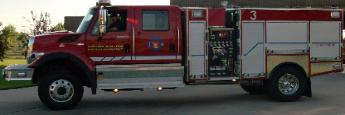
| Loveland's Rural Fire Protection District Truck |
| What the "Incident Investigation Report" States "On Saturday April 17, 2010, at approx. 2327 hrs, Loveland Fire and Rescue (LFR) Engine 5 (E5) was dispatched to an outside smoke investigation in an area of 41st and Boxelder. Initial dispatch reports indicated a large amount of white smoke coming from the residence at the corner of 41st Street and Boxelder Drive. After numerous calls and reports that a specific structure was involved, dispatch upgraded to a structure fire response. LFR Engine 5 (E5) and Squad 2 (SQ2) were the first fire supression crews. Battalion Chief Greg WARD (BAT1) was the Incident Commander of the fire scene. LPD Detective Scott HIGHLAND was the lead investigator from the Loveland Police Department." The response times listed show the first three units arriving at "2333 hrs." |
Story Background Links
1. October 2007 - 97 Acre Purchase Plan Revealed
2. November 2007 Lame Duck Council buys 97 acres
3. August 2008 - Fire Chief resigns
4. June 2009 - CEF's limited plus fire station delayed
1. October 2007 - 97 Acre Purchase Plan Revealed
2. November 2007 Lame Duck Council buys 97 acres
3. August 2008 - Fire Chief resigns
4. June 2009 - CEF's limited plus fire station delayed
| Funding Scheme Oct. 2007 letter to council explaining the way the property purchase is going to be funded (final numbers from the November '07 meeting differ slightly due to staff adjustments between meeitngs) "The City will internally finance the 402 property purchase. The city council capital reserve will provide $1.6 million upfront and the money will be advanced from the accumulated capital expansion fees for fire ($3.2 million) and recreation ($2 million). The city council capital reserve will repay the capital expansion fees at the average interest rate being earned on the City’s investment portfolio for the preceding twelve months, adjusted annually. The City is using the same interest criteria prescribed by the City Charter Section 13-3 (b) for inter-fund loans from the utility funds. The loan is structured with a ten year term, loading the principal repayment in the last five years of the repayment schedule." |